
 Current Issue PDF
Culture
Tribal basket weaver receives Culture Keeper award
By Nicole Montesano
Smoke Signals staff writer
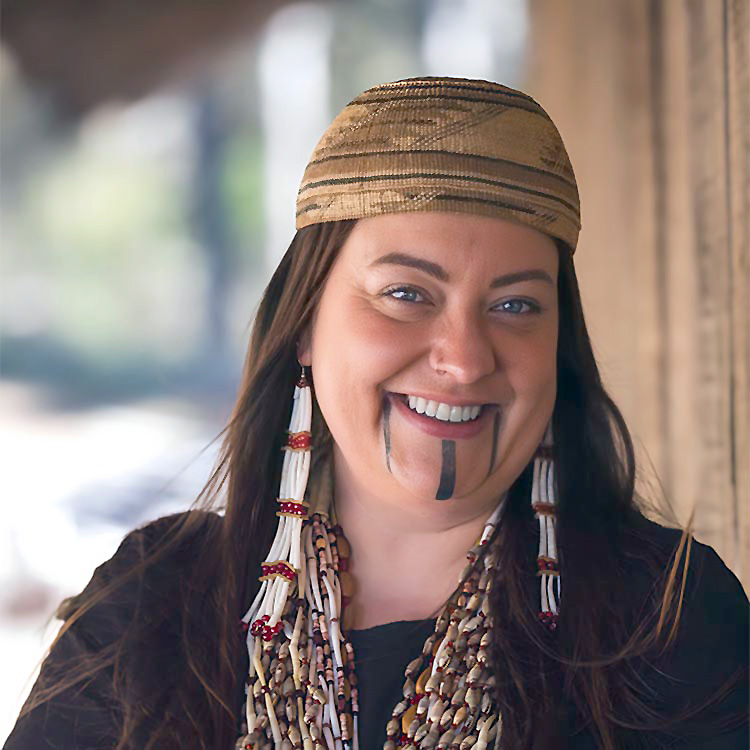
Grand Ronde Tribal member Stephanie Craig has received a Traditional Arts and Culture Keepers Award from the Oregon Arts Commission, in recognition of her work preserving Indigenous basketweaving traditions.
Craig, who received a grant last year from the Oregon Community Foundation’s Creative Heights grant program, teaches traditional Native basket weaving traditions. She also works as a consultant with museums and Tribal museums on proper care of Indigenous belongings through her business, Kalapuya Weaving and Consulting.
She said the Culture Keepers award will help with visibility.
“I think it’s good,” she said. “I received a grant last year to make construction weaving videos, so getting this award will help get the word out about access and getting people connected to their culture, maybe wanting to get connected to their culture. … I didn’t expect it. I never thought in my life I would get such an award or be recognized. That’s not why I do this. Since I was a child, and in school and in college, I’ve seen a lot of Tribal members, not necessarily Grand Ronde but all Tribes, who are not living on the reservation or don’t have access to the reservation. They don’t have access to their culture.”
For Craig, helping to connect Tribal people to their heritage is an important calling.
“As Tribal members, we’re all entitled to our culture and it’s important that we stay connected to it,” she said. “Part of the lessons that I received with learning our culture and our traditions is that it doesn’t stay with me. That I pass this on to others.”
Her career as a basket weaver didn’t begin intentionally.
“I did not set out to be a basket weaver or any of that; I just wanted to give back to my Tribe and my community,” Craig said. “Then it just happened that I’m good at basket weaving. That I love it. But my mom and a lot of Elders in community told me that the family I come from … if it wasn’t for them, I wouldn’t be there. I was told they chose me to carry these teachings on. I feel because of that responsibility, that I have to continue it.”
Craig is descended from legendary Grand Ronde basket weaver Martha Jane Sands, and from Sands’ daughter, Hattie Sands Hudson, who carried on Sands’ work and whose daughter was Craig’s great-grandmother.
Craig grew up on her father’s heritage farm, surrounded by her Tribal family, where, from both sides of her family, she learned to admire hard work, and the big, capable, caring hands that carried it out. As a child, she said, she wanted hands like that, too.
“Martha Jane and Hattie and (her husband) Moe, they worked really hard to take care of their family,” Craig said, and she watched her parents do the same.
But she didn’t dream of becoming a basket-weaver.
“It’s funny how things turn out,” she said. “I didn’t expect to be a basket weaver at all. I loved history and I went to study anthropology and archelogy. This gift, I would say, was kind of given to me by my ancestors.”
She began her teaching practice by seeking the Elders approval.
“I went through protocol and asking permission, from the oldest male Tribal member and the oldest female Tribal member at the time, and sat and talked with them,” Craig said. “There were things they told me I couldn’t share with non-Tribal people, and 20, 25 years later, I’m still following those same rules.”
Craig said her work as a basket weaver also plays into her work with museums.
“My academia training is very white washed,” she said. “There’s no Indigenous thinking or ways of knowing or implementing Indigenous practices into museum practices. So, when I go and walk through museums, I’m looking through two different lenses.”
As a basket-weaver, she has to have an understanding of botany, cultural resources, spiritualty, Indigenous gender roles, soils and hydrology.
“A person even has to know about chemicals and how pesticides and chemicals can interact and change the environment the plants are growing in, which changes the cellular structure of the plant itself,” she said.
All of that, and a knowledge of which traditional basketry plants grow in which region and were used by local Tribes for their different basketry traditions, she said, helps to inform her work with museums.
Nonetheless, Craig rejects labels.
“I’m not an expert at all,” she said. “I was taught by my Elders that we’re not a master of anything until the day we die, because we’re always learning something new. And I stand by that, because at every workshop I teach, I learn something new.”