
 Current Issue PDF
Tribal Government & News
TERO holds annual appreciation lunch, names worker of the year
By Danielle Harrison
Smoke Signals editor
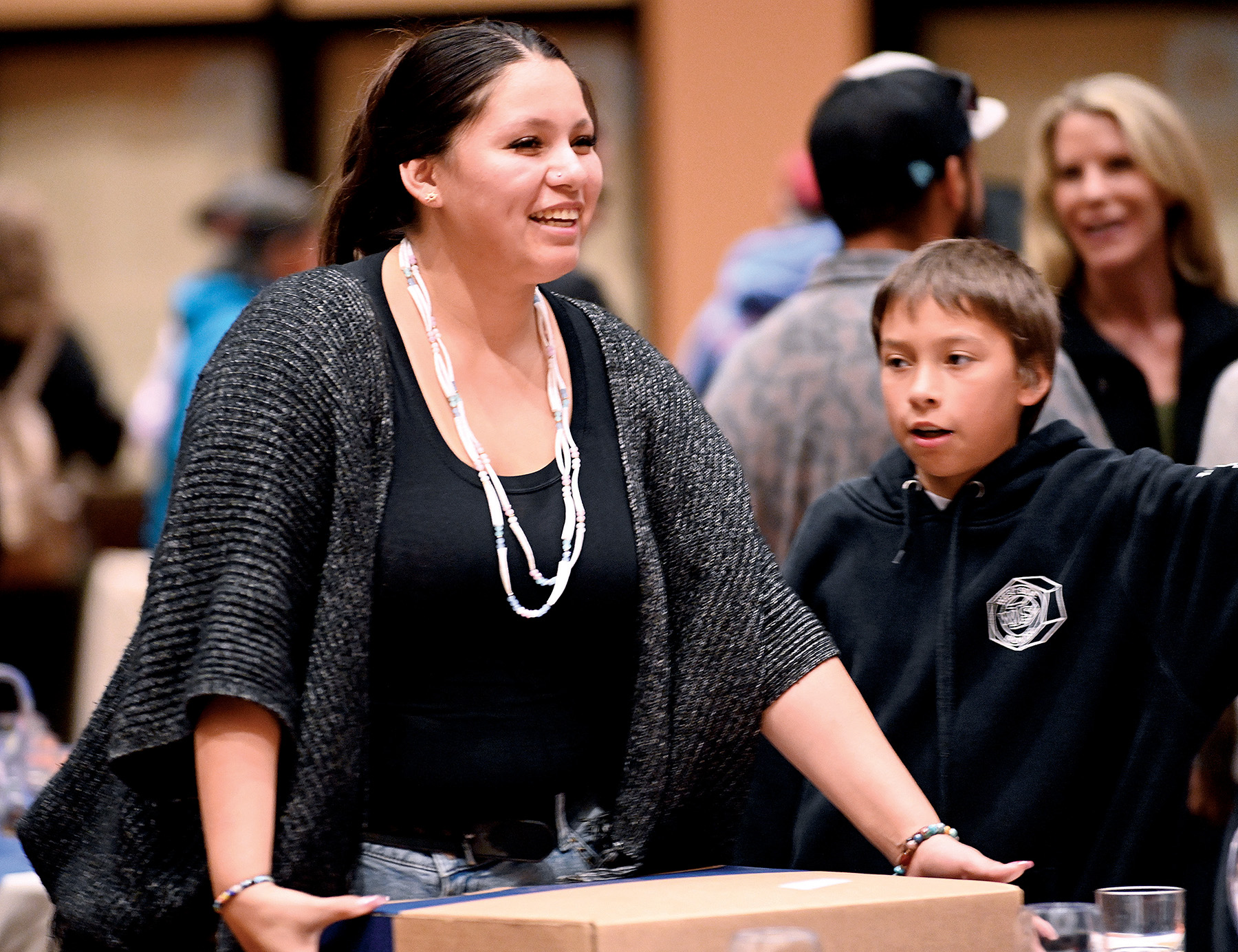
The annual Tribal Employment Rights Office Appreciation Lunch was held Saturday, Oct. 24, at Spirit Mountain Casino’s Event Center to honor and highlight employees and projects in 2026, and to honor the worker of the year.
TERO Director Harris Reibach served as master of ceremonies, introducing speakers, presenting awards and announcing raffle winners while approximately 200 attendees enjoyed lunch and desserts.
Reibach took a moment to acknowledge all who had come out for the event, and noted it was the third time they had invited primary contractors for various Oregon Department of Transportation projects that employ TERO workers. He also acknowledged WorkSource Oregon, which brings a mobile center to the Tribal campus twice a month.
“This is a great place to meet people” Reibach said. “There might be some opportunities where someone may have wanted to engage with the program, but never really kind of got the chance to, and they might see you and say, ‘Hey, this is the time where I could just go up and talk to the person that’s in that program,’ so I appreciate all of you for coming. It’s awesome and it really means a lot.”
Reibach acknowledged the Klamath Tribes TERO, who first visited the Grand Ronde TERO program in 2025 after launching their program, and who have now attended the luncheon for the second year in a row. He also acknowledged that everyone in the room was connected in some way.
“It’s just a time for us to come together,” he said. “We’re all related in some way or another through employment, through TERO or through the state. We all have some kind of engagement with the ultimate goal of seeing our Native people be successful, so if you’re sitting at a table now, you definitely play a part in that success.”
Then, Reibach gave the invocation to begin the event and Tribal member and past TERO participant Fabien Quenelle performed a drum song.
Reibach introduced employees in the TERO program, which includes Senior Compliance Officer Duke Kimsey, Compliance Officer Matt Lux, Training and Development Coordinator Jacob Boekhoff, Senior Executive Assistant Caden Leno, Administrative Assistant Kristy Summers and Khofi Haws Lead Barista Ariel Hunt. Past TERO staff member Lori Sterling was also in attendance.
Then, Reibach mentioned TERO Commission members in attendance, which included Sterling and fellow Grand Ronde Tribal Elders Perri McDaniel and Steve Bobb.
Reibach thanked Tribal Council member Valeria Atanacio and Tribal 477 Employment and Training Program for attending the lunch.
After a meal song, a lunch of prime rib, turkey, potato salad, fruit salad, mashed potatoes, green salad, rolls and dessert was served.
Lunch and dessert were followed by raffle prize drawings, an explanation of the various services TERO provides and various project statistics.
“The level of engagement that Grand Ronde TERO has with the individuals and the contactors that we work with, I think that’s what makes us stand out,” Reibach said. “For those that don’t know and this always feels like a humble brag, but we are one of the most successful TEROs in the United States. There’s over 300 and Grand Ronde is one of the most successful. It’s like a culmination of things, but a couple things that I have down is the engagement and communication…If you call us, if you email us, we will always answer those or get back to you as quickly as possible. And of course, the dedicated staff goes right into what makes this possible.”
Reibach also highlighted a few areas in the program that he said helps with its success, such as the TERO Skills Bank, where prospective workers fill out a simple application and send it in with a copy of their Tribal ID or ID from any federally recognized Tribe. Then, they can begin calling in daily to be matched with employers looking for employees.
“The skills bank is full of all different kinds of construction trades workers so we have carpenters, laborers, flaggers, equipment operators, painters, you name it,” Reibach said. “We also do apprenticeships through there, not only with unions but non-union as well.”
The other aspect Reibach highlighted is the Indian Owed Business program.
“There’s an application you can get grandronde.org/government/tero/ and there’s a wide variety of companies on there, anything from smaller, mom-and-pop companies to bigger consulting companies and everything in between. We also have a non-construction related individual businesses, too.”
Lastly, he noted the individual funding opportunities, which are only available to Grand Ronde Tribal members and descendants.
“We fund a lot of things through that program and really, it is a catch-all for non-accredited programs…It has really come in and stepped up to help with those,” Reibach said.
He added that 2026 had been a great year for the program and noted a few of the highlights, which include the Interstate 205 Abernathy Bridge project, which is the biggest project for TERO and is now in its third year.
“We constantly have a lot of people out on that project,” he said. “And that’s been a really good project for engagement and we’re working with some good contractors on there and have referred 70 people this year. Sixty individuals have been hired on over the duration of that project, so it’s been really good for us.”
He mentioned that TERO had received its first ever federal grant, EAGLE, which stands for Economic Advancement Grants for Local Empowerment, a funding initiative launched by the Administration for Native Americans.
“There were around 200 people and entities that applied, and we were one of 30 that received it, so that should be rolling out at the beginning of next year,” Reibach said. “It will help specifically fund those OJTs where we can get people working on projects and pay their wages.”
Another upcoming project is the interstate bridge replacement, which will involve replacing the I-5 bridge from Jantzen Beach in Portland to Vancouver. Grand Ronde is one of four Tribes engaged on the project, along with the Yakama, Warm Springs and Cowlitz Tribes.
“That will be the first project ever that is multiple Tribe by state federal funded project,” Reibach said.
Altogether, TERO workers were dispatched to 27 projects this year between 10 ODOT projects and 17 Tribal projects. The total hours worked were 34,747, which resulted in $1.348 million in wages.
Some of the bigger Tribal projects include the Wind River Apartments, with 10 buildings and 45 units being added to Tribal housing, along with phase two foundation for the Tribal homeownership development, Tipsu-ili’i and the exterior painting project at Spirit Mountain Casino.
After Harris finished with program highlights, he then provided the opportunity for the TERO staff to speak about their jobs and what those meant to them.
Toward the end of the event, the TERO Worker of the Year award was presented to Kayonda Flores, who was also a TERO Worker of the Month in March 2026.
In a Worker of the Month article in Smoke Signals, Flores discussed how her apprenticeship as an iron worker had changed the trajectory of her life.
“Prior to utilizing TERO, Kayonda was living in a homeless shelter with her two young sons,” the article stated. “A staff member at the shelter provided her with a pamphlet and told Kayonda about Grand Ronde TERO and the career opportunities it may afford someone in her position. Kayonda’s goal was to establish a career that would support her and her children, while also allowing her time to spend with them. Kayonda shows sincere gratitude for getting this opportunity through Grand Ronde TERO. She works hard each day to capitalize on the learning opportunity that the day brings.”
Flores was presented with a Tribal Pendleton blanket, plaque, one-night stay at Spirit Mountain Casino with a $50 meal comp, two comedy tickets to Chris Tucker, as well as Visa, Amazon and Shell Gas gift cards.
The event concluded with a final raffle and photos.