
 Current Issue PDF
Culture
Plants for People showcases Tribe’s restoration work
By Nicole Montesano
Smoke Signals staff writer
During the past decade, the Tribe has worked intensively on land restoration, focusing particularly on returning first foods and other culturally important species to the landscape for Tribal access.
It partnered with the Institute for Applied Ecology for the Plants for People project, which was funded by a grant from the Oregon Watershed Enhancement Board. The work included planting 45 culturally important species across 178 acres on seven different sites, including Herbert Farm and Natural Area, owned by the city of Corvallis, and Champoeg State Park.
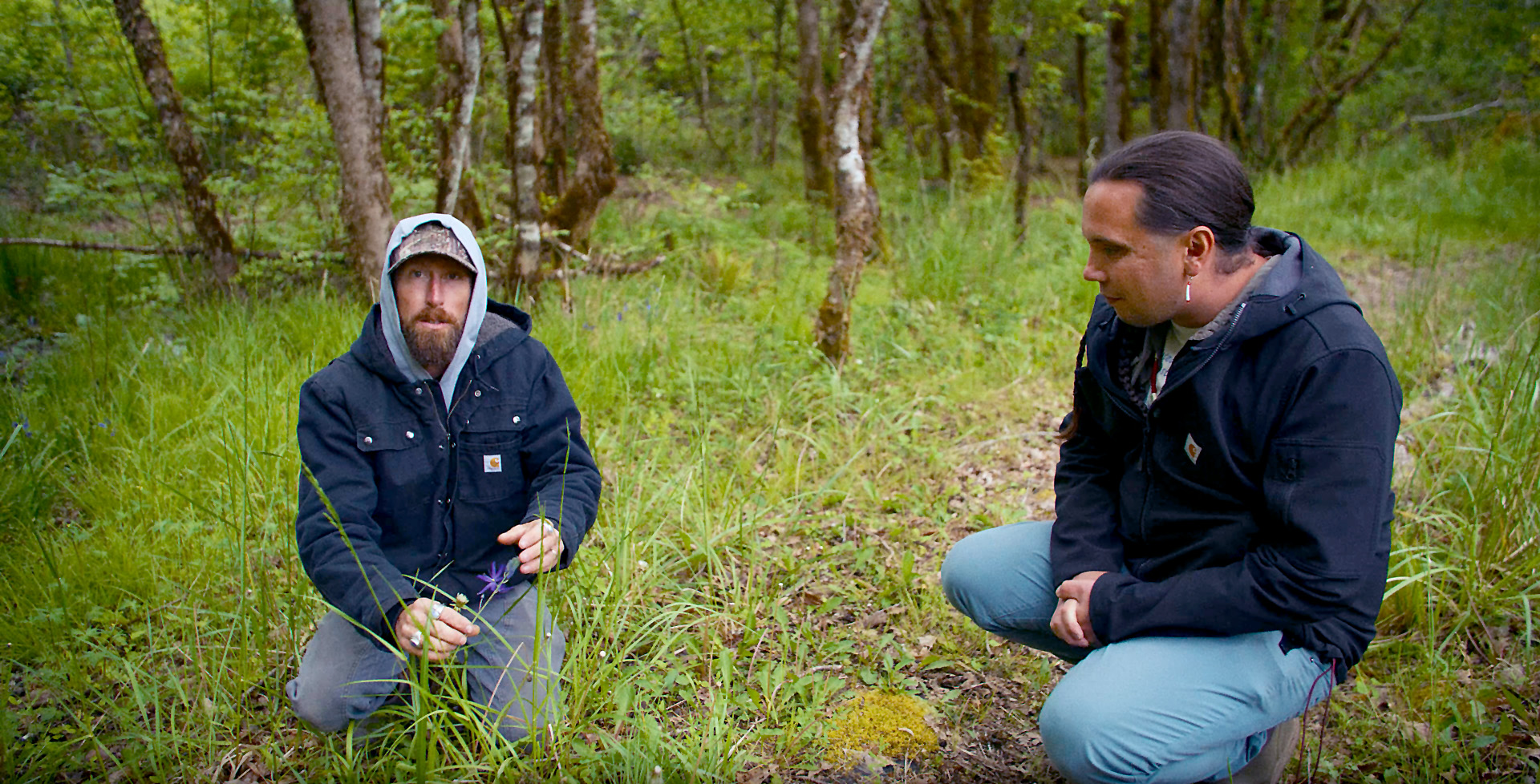
This spring, the Tribe released a series of three videos about the projects at Herbert Farm, Champoeg State Park and the Tribe’s own Native plant nursery. The videos feature Tribal Cultural Policy Analyst Greg Archuleta, Cultural Resources Manager David Harrelson, Native Plant Nursery Supervisor Jeremy Ojua and Native Plant Nursery Assistant Joseph Ham, talking about the importance of restoration work. Archuleta, Harrelson and Ham discuss what it means to them personally as Tribal members.
The whole thing started, Harrelson said, in the early 2000s, when Melanie Gisler of the Institute for Applied Ecology asked the Tribe if she could work on propagating and maintaining Nelson’s checkermallow, a native plant, on Tribal land.
“It wasn’t really a part of anybody’s work plans; they didn’t have capacity for it, and at the time the biologist, Rebecca McCoun-Travers … was taking her lunch breaks and basically helping Melanie, because the Tribe was like, ‘Yeah, sure, but we can’t put any staff time or resources; we have no plan for this,’” Harrelson recalled. “Melanie started asking a bunch of questions about native plants. And Rebecca was like, ‘I don’t know about all this cultural use stuff, let’s go talk to the Cultural Resources Department.”
Harrelson “had just moved from the Natural Resources Department to the Cultural Resources Department … and she roped me in. I started to spend my lunch time hanging out and I started to give feedback,” he said.
Harrelson said he had noticed an issue with plant restoration efforts.
“There’s this missing gap: People ask us for plant lists, we give them a plant list,” he said. “Then they go to the nursery and they get the plants that have the Latin name, but they don’t have the genetics that we want. Like, the sedges are all wrong and the big standout was anytime the Tribe did development, we put in kinnikinnick (bearberry plant). And the kinnikinnick that they were getting was this high wax glossy ornamental kinnikinnick, which is not the type of kinnikinnick that we use.”
Gisler suggested that the Tribe grow its own plant material and applied for an Oregon Watershed Enhancement Board grant with the Tribe as the partner beneficiary, “with the idea that the seeds and the plant material produced from that would go to some of the sites that Institute for Applied Ecology worked on,” Harrelson said.
Gisler moved on after a year.
“But now we’re 10 years into that sort of evolving of iterations and different staff who’ve worked with the Tribe a lot longer, changing into different roles but it kind of all happened over lunch, doing extra work at the edges of something that seemed to matter,” Harrelson said.
The grant enabled the Tribe to create a native plant nursery, with unexpected results.
“It created this community outreach component for Natural Resources,” Harrelson said. “That was like an unintended benefit of plants for the people, in a real way. Not just for the outcomes in the field, but the whole process of growing those plants has made a huge community contribution. That wouldn’t have happened without Jeremy and Joseph.”
In the video, Ojua and Ham discuss the community interactions the nursery has created, including regular visits from schoolchildren.
Creating the series took about a year, Tribal Public Affairs Digital Communications Manager Matthew Williams said. He hired a videographer and editor to help, but also did some of the shooting himself.
“Days were always really long,” he said. “They were a lot of work, but really fun, when you look back.”
The site visits involved hours of interviewing and shooting video, followed by countless hours of editing. The theme of the videos is efforts to maintain Tribal culture.
“It’s really important for a Tribe that’s been through Termination and figuring out how we stay connected to that land is kind of the goal of that series,” Williams said.
“We refer to it in community as ‘keeping it living.’ … Our history is written upon the landscape, because the land holds it. It keeps it, so it’s there for our own finding,” Harrelson said.
In the video, Harrelson said he often brings his children to Champoeg.
“One of the greatest challenges that we face is just the sheer volume and size of the loss that’s been experienced by our Tribal people,” he said. “And so, one of the greatest ways that we can proclaim and be a part of our own persistence is to engage in those old ways of thinking and doing. But without the ability to get to practice our culture on the landscape, our culture isn’t living. It becomes static. … A number of teachings that we have, I think are really pertinent to traditional ecology knowledge. One is this concept of managing for abundance and this idea that as humans, maybe the greatest gift or power that we have is the ability to take actions that beneficially impact not only us, but also plant communities, animal communities around us. And so often that is a stark contrast to the way that environmental preservation has been viewed, which is an understanding that people are bad and things that people do are somehow negative to the environment,” Harrelson said.
The videos “take a lot out of you, because you’re constantly working through every small detail and trying to make sure everything is right,” Williams said. “Even the music and the way someone ends their sentence … pulling the best bits that make the most sense for it.”
One of the challenges, Tribal Natural Resources Specialist Annaliese Ramthun said, was how much had to be cut out.
“There would be 40 minutes of really interesting information and that we then had to edit down to highlights,” she said. “That was the hardest part of the process. This is 10 years of a project, based on 200 years of displacement, and there’s still so much work to do. How do you pick 15 minutes of highlight reel?”
The videos are available on the Tribal website at www.grandronde.org/videos/.