
 Current Issue PDF
Culture
Tribe and university celebrate Camas Festival
By Nicole Montesano
Smoke Signals staff writer
MCMINNVILLE -- It was a perfect day for the Camas Festival on Friday, May 1; sunny and warm, with the tall flower spikes in full bloom against a backdrop of green along the creek bottom by the Linfield University campus.
The annual festival is the result of a partnership between Linfield University and the Confederated Tribes of Grand Ronde.
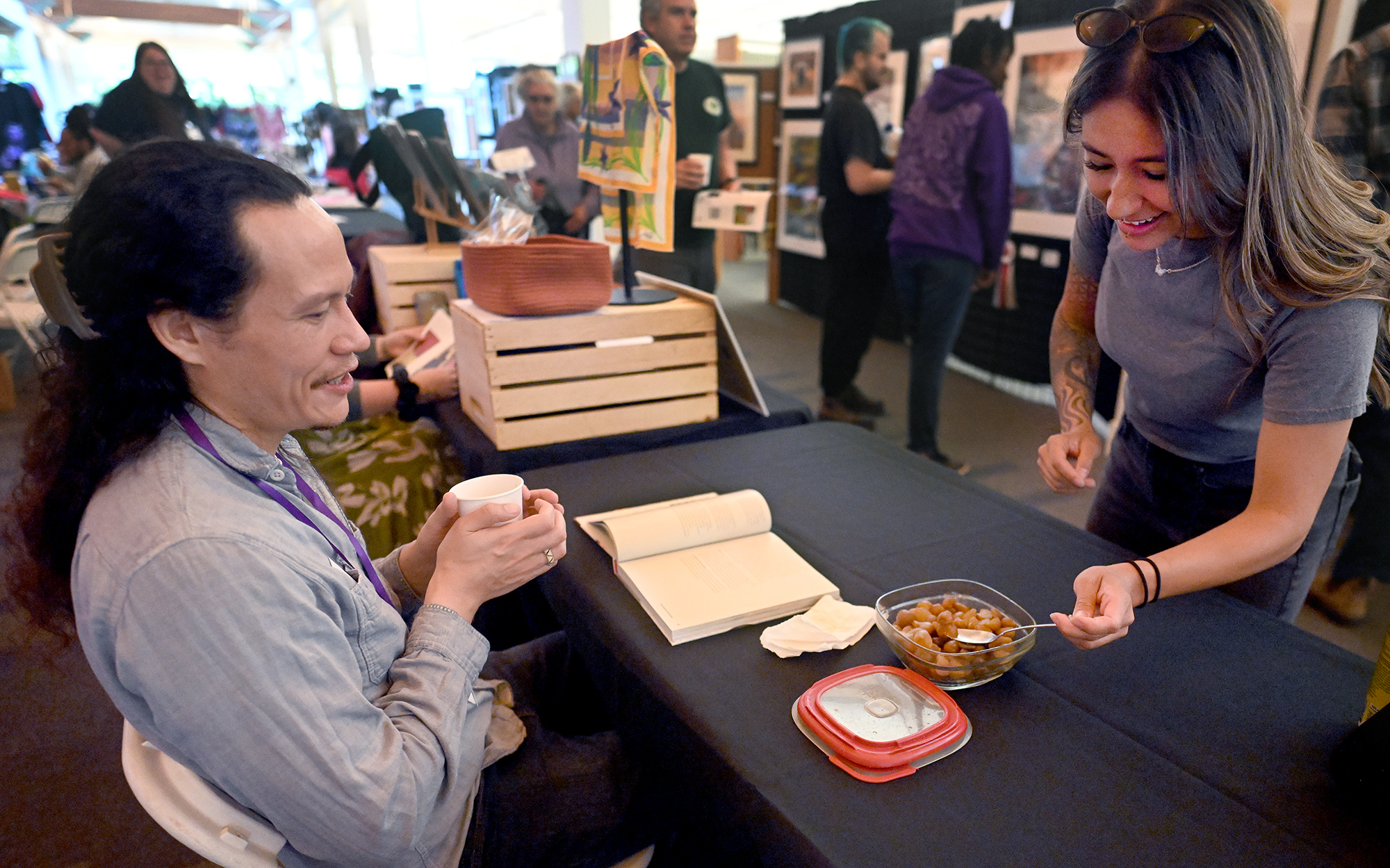
Dozens of people attended, eager to view the camas in bloom, listen to presentations about the iconic flower and taste samples, harvested a few days earlier by the Tribe and slow cooked in a crock pot.
Attendees also had the opportunity to pick up some camas seeds to plant, view an artist gallery of work featuring camas and browse the pop-up Indigenous market and the displays from Chachalu Tribal Museum & Cultural Center.
“Linfield sits on the traditional and unceded homeland of the Kalapuya people, who were removed to the Grand Ronde reservation in 1855,” Linfield University President Mark Blegen said. “The Camas Festival exists to honor and express deep gratitude for the Kalapuyan peoples who were the original stewards of this place and whose relationship with the land remains unbroken. We are grateful that they are here to share some of those traditions with all of us.”
Tribal Council Vice Chair Chris Mercier and Tribal Council Secretary Jon A. George attended the event, with Mercier making opening remarks, noting that the festival is now in its fifth year.
Mercier told the audience that 150 years after the forcible removal of Tribes to Grand Ronde, an area where many of them were unfamiliar, “a lot of our knowledge of our Indigenous foods has been lost. I want to emphasize, lost. Not wiped out; there are some people who still are their own little towers of knowledge that you can go to.”
“But here’s why it’s important for Tribal people,” Mercier said. “There have been multiple studies done … about how Indigenous people, when given the opportunity to consume some of their traditional foods, every sort of health metric that you can imagine associated with diet has tended to improve.”
Making those First Foods widely available, however, is a challenge, Mercier said.
“I live in a community of hunters, so you know, getting game meat isn’t that hard but when I’ve been out with people who really know what the food is, I’m amazed by how many plants that we walk by in our hikes, that at one point were a source of sustenance for our Tribal people,” he said. “When I talk about how knowledge is lost and how it’s being regained, that’s exactly what I’m talking about. I would have never known that you can eat nettle; that’s not something you normally think, ‘Oh, I’m going to go eat some nettle,’ because if you’ve experienced nettle, eating it is the last thing that you think of. But it’s doable and camas produces these gorgeous flowers. Don’t eat the white ones, just so you know. But who’d have known that it was a staple of the people.”
The festival features tours of the camas growing along Cozine Creek behind the president’s house on campus.

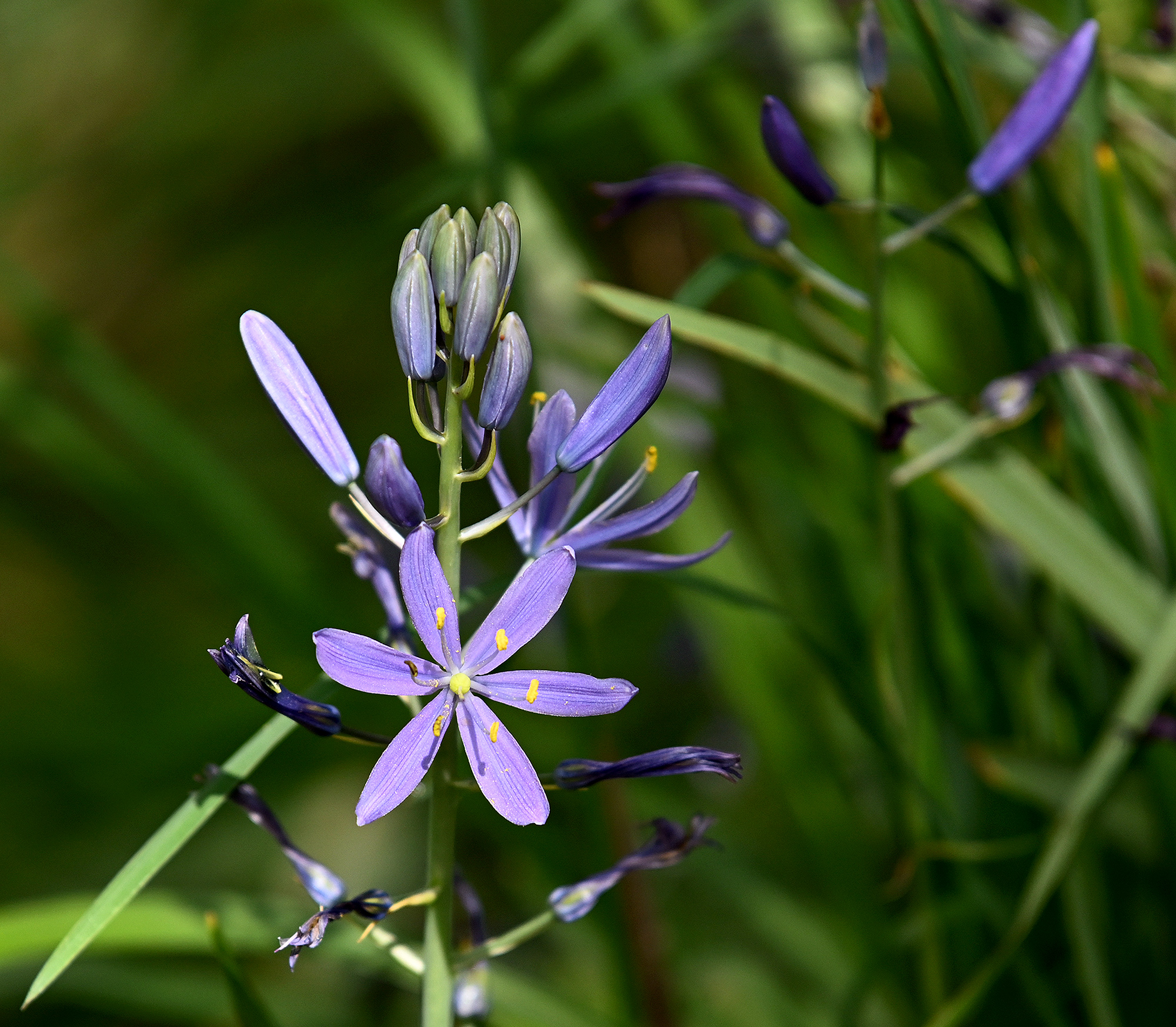
Camas is in bloom in the Cozine Creek camas patch at Linfield University in McMinnville Friday, May 1. (Photo by Michelle Alaimo)
“That patch may very well have been cultivated and harvested since before the arrival of European settlers to this region,” Blegen said. “For years it lay hidden, overgrown by invasive Himalayan blackberry until environmental studies students, as part of a broader Cozine Creek restoration effort, cleared the way and allowed it to re-emerge. But the camas was here all along, quietly enduring as a lesson in resilience.”
Blegan said that resilience “echoes something larger. The resilience and endurance of the people who have tended this land for generations. Camas also offers us another lesson; one that feels important to hold onto. That human beings can be a positive force for the natural world. That is a counternarrative worth celebrating. As we have learned from our Tribal partners, when camas is harvested in the right way, with traditional tools and knowledge, it doesn’t deplete the patch. It improves the soil and makes it healthier over time. Reciprocity, not extraction.”
Tribal members are still working on relearning how to prepare many First Foods. The traditional method for preparing camas, Tribal member and Cultural Resources Specialist Chris Rempel explained during an afternoon presentation, is to cook it underground in a pit oven for two or three days, which slowly changes the inulin fiber in the tubers into a more digestible form.
It turns out there’s a lot to learn, Rempel said. The bulbs must be peeled the day they are harvested or they become intractably sticky, and peeling takes much more time and effort. They must be cooked long enough to be sweet and flavorful, but not over-cooked, which may mean anywhere from 48 to 60 hours.
The traditional pit oven technique, he said, has not so far yielded great results for him, despite several attempts. The first one, a few years ago, he said, resulted in bulbs that were “burned to a crisp,” because the oven had been too hot. The next attempt, using some insulation between the bulbs and the fire, worked, but the bulbs were smoky-tasting, dry and leathery.
The problem, Rempel said, is that “you don’t know how much heat you’re trapping in the oven,” with no way to gauge the temperature. So, he turned to using a crock pot instead, which has yielded better results. Rempel said he has tasted really good camas bulbs – dark brown, sweet and flavorful – but hasn’t quite figured out how to achieve that result consistently.
In addition to storing baked camas bulbs over the winter, some Tribes formed camas cakes, sometimes mixed with dried fruit or berries.
“I’ve never seen a description of the texture; just the process,” he said.
He tried mixing some with dried serviceberry and baking it.
“It tasted Ok, but it was very leathery,” Rempel said. He put the next mixture in the blender with some water, before forming it into cakes and baking. This one refused to hold together, crumbling into powder. Rempel said he also mixed some of the camas with huckleberries but felt that they overwhelmed the camas flavor.
The Tribe is also experimenting with growing conditions. On a site near the powwow grounds, it has divided a field into four squares: A control plot, where no action is taken; a plot that is mowed, a plot that is burned seasonally and a plot where the Tribe does both mowing and burning. The idea is to compare how each of the plots does over five years.
So far, Rempel said, the mowed-only patch has produced the thickest blooms, but it’s not yet clear which plot will ultimately produce the best quality or how the soil will respond to the different treatments.
As with the Linfield site, members of the Tribe’s Cultural Resources Department told the audience that camas can be present but unnoticed in areas long turned to other uses.
“In 2005 or 2006, there was a wildfire on this property (at the time under different ownership),” Cultural Resources Department Manager David Harrelson said. “And every year after that, the camas exploded.”
The landowners later sold the property to the Tribe.