
 Current Issue PDF
Culture
Nisqually Tribe welcomes canoe families
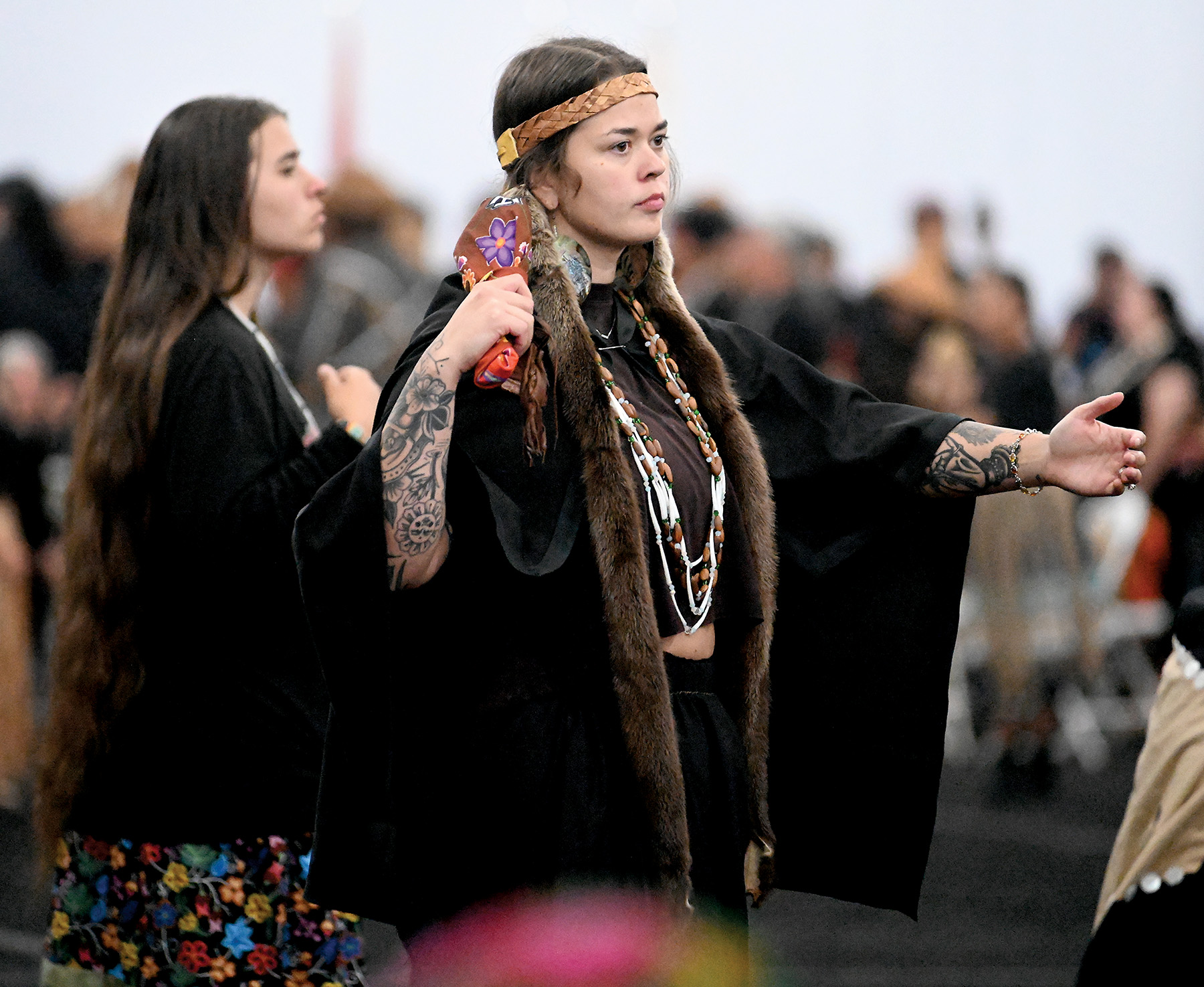
By Nicole Montesano
Smoke Signals staff writer
DUPONT, WASH. -- Members from dozens of Pacific Northwest Tribes and beyond, including Grand Ronde, gathered on Friday, July 31, to watch and wait for the arrival of the canoes participating in the Paddle to Nisqually Medicine Creek Potlatch 2026 Canoe Journey.
Those who wanted to see the canoes arrive at the rocky shoreline along Puget Sound had to walk down a 1.5-mile forest path to the water. The walk was punctuated by calls to step aside as gators drove by, loaded with chairs and passengers who needed an easier descent. Host Nisqually Indian Tribe had commissioned commemorative water bottles, emblazoned with this year’s journey logo and filled with water enriched with electrolytes, that were handed out to help keep watchers hydrated. A first-aid booth was stationed at the end of the trail.
The 2026 Paddle to Nisqually Medicine Potlatch was an opportunity for more Tribes to participate in the Landing Day ceremony, after rough waters in 2025 led to many, including Grand Ronde, deciding to forgo their official landing out of safety concerns. Tribal peoples from as far away as Alaska, Canada and Hawaii participated, with 75 canoe families registered to participate. Some, including Grand Ronde, had been pulling for days.
The Nisqually Tribe’s website noted that “The Canoe Journey has grown to include over 100 canoes and the participation of canoe families from other Native canoe cultures, including Native American Tribes, First Nations peoples, Alaska Natives, Inuit, Maori, Native Hawaiians and other Indigenous peoples from across the world.”
Landing Day arrived sunny and warm. Canoes were scheduled to begin arriving at noon, but the tide “was just really pumping through there,” Tribal member Andrew Freeman said. “There was no way you could fight that. … they were like holding still and paddling at full speed.”

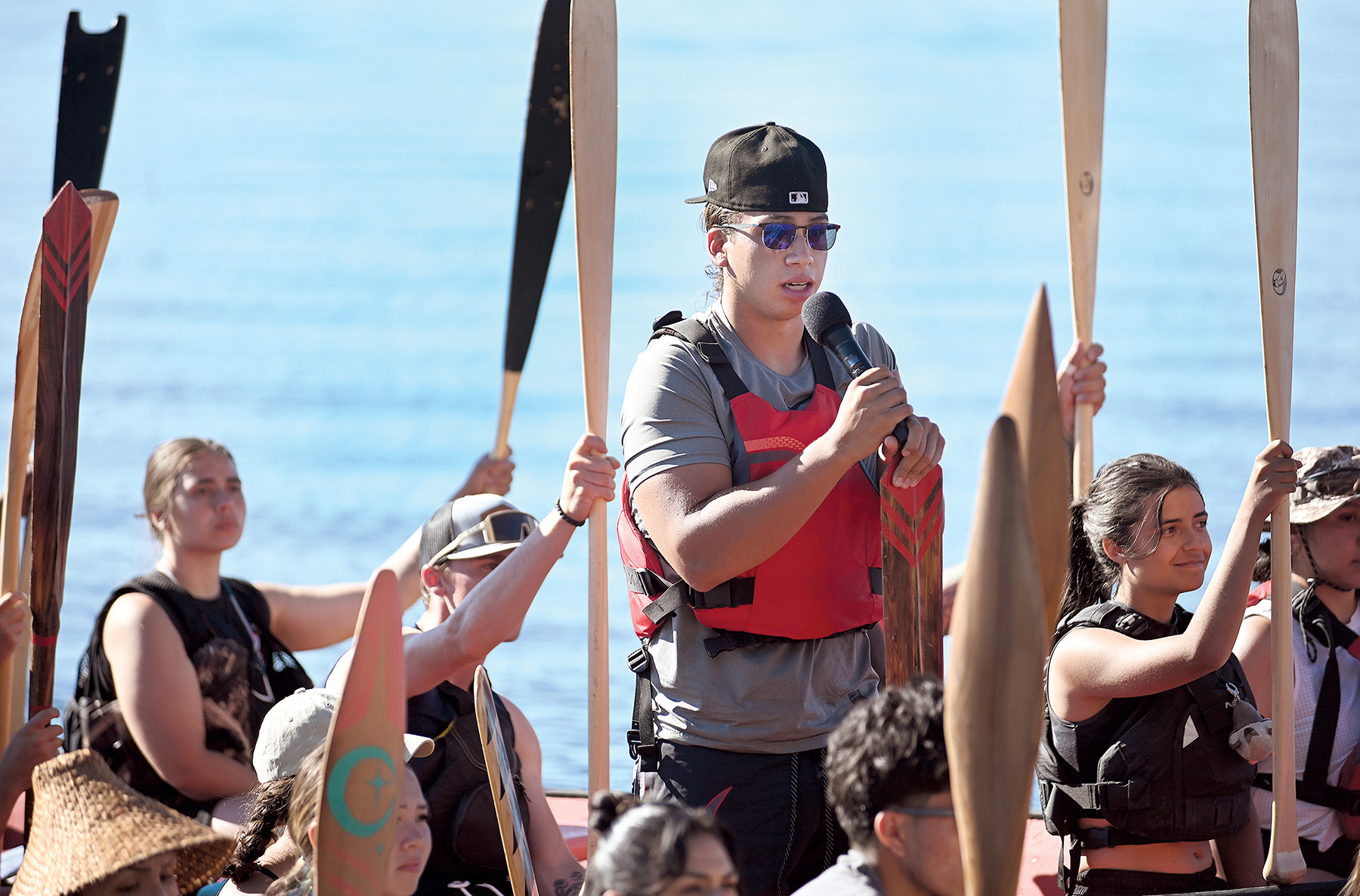
Tribal member Kaikanim Mercier introduces himself and asks for permission for the Grand Ronde Canoe Family to come ashore as they land during the Paddle to Nisqually Medicine Creek Potlatch 2026 Canoe Journey at Sequalitchew Creek in DuPont, Wash., Friday, July 31. (Photo by Michelle Alaimo)
Some canoes pulled over to wait until the tide subsided, others kept paddling.
“I’m assuming that came into play, but what I’ve realized is you have a plan and you try to stick to it, but it’s really just whenever you get there it’s meant to be,” he said.
While the crowd waited, curious seals bobbed in the waves and a flock of Canada geese grazed a nearby wetland. Small children splashed in the shallows of Puget Sound, while adults sought shelter from the sun in tents and the scattering of trees above the shoreline. A drone flew above the water and police patrolled the area.
When the first canoes appeared near the Sesqualitchew Creek landing site at 2 p.m., their occupants paddling hard down the length of the bay from Solo Point before circling in respect before the assembled people, they were welcomed with singing and drumming.
Members of the Nisqually Royalty, Elders and Tribal members took turns speaking to the arriving canoes, welcoming them to the homelands of the People of the River, People of the Grass. As the afternoon wore on, canoes began lining up across the bay, waiting their turn to speak with the Tribe.
Pullers from the Confederated Tribes of Grand Ronde made their landing at 5:30 p.m., tired and hot after a day spent on the water, but singing as they arrived, rowing alongside the Suquamish-based Tana Stobs Canoe Family. Grand Ronde landed two canoes this year; stankiya (coyote) and chicha (grandma).
Freeman said the pullers had gone approximately 29 miles the previous day and 25 miles on Landing Day.
After formally asking and receiving permission to come ashore, the canoes returned to Solo Point to disembark.
Tribal member Mary Lopez, an assistant teacher for 4 and 5-year-olds at the Shawash-ili?i Skul, watched from the shore.
“I’ve been part of the Grand Ronde canoe family, since I was a youth myself,” she said. “I’m now 34 years old. It makes my heart full seeing our youth on the canoe, speaking in our language like that, asking permission to come on the shore. I hope to take what I’ve seen here, the feelings I get, home to my family and our community.”
Her boss was on one of the canoes, Lopez said, but added, “I feel like they’re all my family members.”
The week-long journey led Grand Ronde pullers through stretches of the Willamette and Columbia rivers, from Newberg to Champoeg, where they camped overnight before rowing onward. The trip included a stop at Rooster Rock and at Chinook Landing Marine Park in Fairview, before they traveled to Washington.
Freeman staffed one of the support boats while his wife Brittany pulled a trailer. Their son Isaac, 11, was one of this year’s pullers, while 9-year-old Kaylee, Riley, 14, and Cloey, 16, went along for the experience.
Freeman said he asked each of them about their favorite part of the trip. Kaylee’s was the gang of raccoons that raided the family’s supplies at Champoeg, he said.
“Chloe said she loved seeing the new areas and the beautiful scenery. It was our first time on Puget Sound,” he said. “Riley, her favorite part was making new relationships and meeting new people.”
Isaac was the only one that paddled and he said his favorite part of the journey was being mentally ready to put in work.
For Freeman, it was the entire experience.
“I didn’t grow up in the culture, but at Suquamish, Isaac was drumming and singing; Riley was out dancing,” he said. “One thing that was awesome in that moment; I was sitting there at the back and he’s out there jamming out on a new drum that his aunt just gave him…I was just looking at everyone’s faces; they were all smiling and it was a visual reflection of how I was feeling inside. Chloe was sitting next to me. My wife and our youngest were sitting outside, hanging out with everyone else. It was my sister’s birthday, so that was pretty awesome.”
Spending time relaxing with others in the community, being welcomed into new Tribal spaces and invited to feel at home there, and seeing the strong connections the Tribe has with other Tribal communities and meeting other artists stood out as special memories, Freeman added.
Next year, Landing Day will take place in Ketchikan, Alaska.