
 Current Issue PDF
Culture
Tribe showcases oak habitat restoration during Noble Oaks tour
By Alexander Bliven
Smoke Signals intern
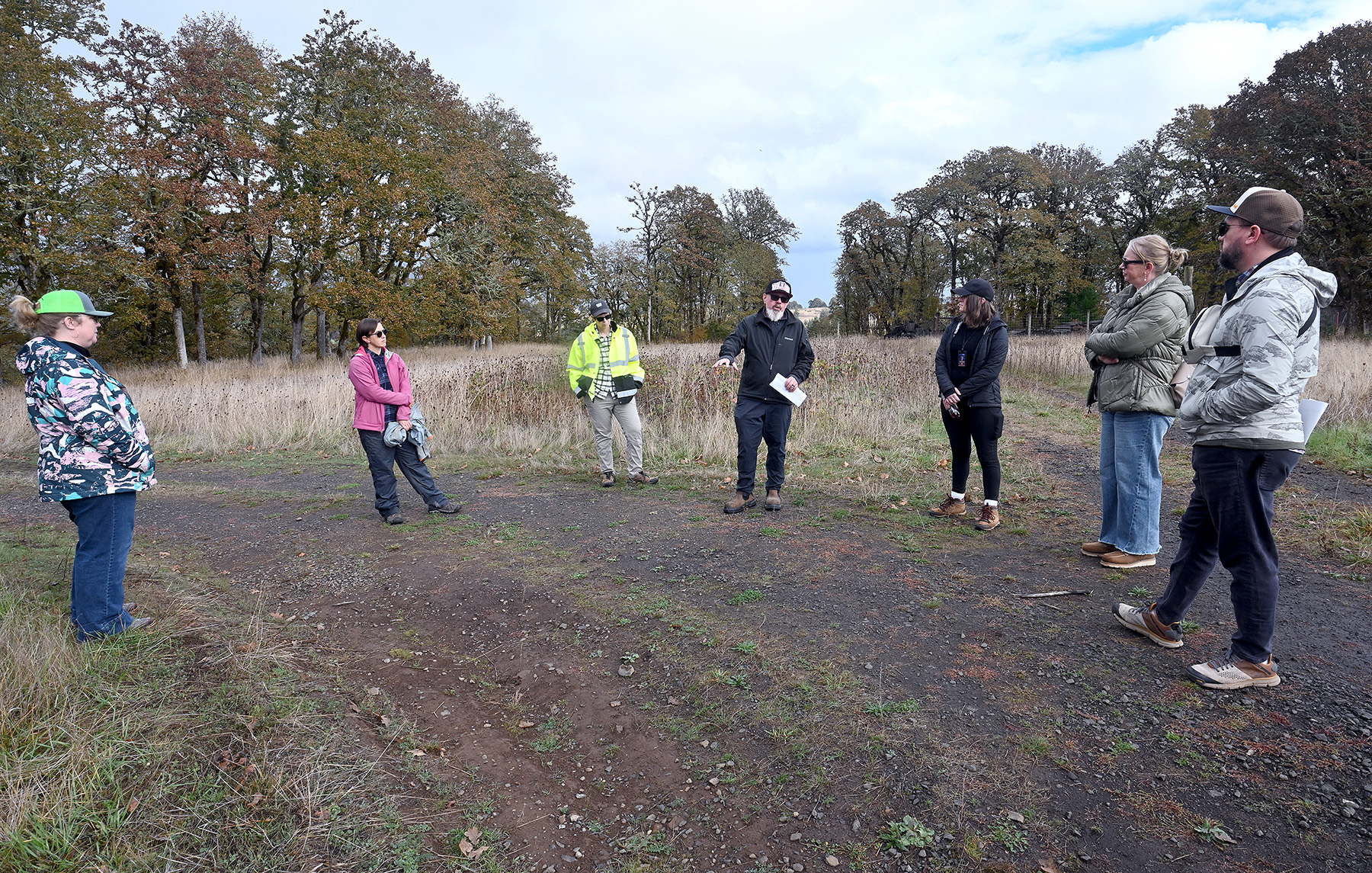
The Confederated Tribes of Grand Ronde hosted Clackamas County representatives Monday, Oct. 26, providing a tour of its Noble Oaks property, a 667-acre conservation site near Willamina where the Tribe is working to restore native oak and prairie habitats.
County staff requested the visit to learn more about the Tribe’s conservation efforts and observe its land management practices firsthand. Tribal Ceded Lands Manager Michael Karnosh organized the tour for personnel of the Clackamas County Government Affairs Office, Forestry Department, and Transportation and Development Department.
Karnosh began by discussing the property’s historical and cultural significance, explaining that it sits on the traditional homelands of Kalapuya people, who managed the Willamette Valley landscape through traditional fire practices for thousands of years.
The property changed hands several times before Richard and Nancy Noble purchased and developed it into a wildlife sanctuary featuring African animals, including giraffes, zebras and rhinoceroses.
Later, The Nature Conservancy, a global nonprofit organization dedicated to protecting land and water, purchased the property using funds from the Willamette Wildlife Mitigation Program. The program is funded by the Bonneville Power Administration and administered by the Oregon Department of Fish and Wildlife.
The Nature Conservancy later worked with Grand Ronde and the program to transfer ownership and conservation duties to the Tribe in 2019.
During the tour, Karnosh, Tribal Historic Preservation Office Manager Briece Edwards and Tribal Wildlife Biologist Marie Vicksta discussed the importance of controlled burning and the Tribe’s ongoing efforts to restore the property’s Oregon white oak savanna and woodland habitats.
“Fire is an ingredient, whether it’s controlled and deliberate or catastrophic and undesired,” Edwards said.
At the first stop, overlooking a burned section of the property, county staff asked several questions about what the process of restoring its lands is like for the Tribe. Vicksta explained that although controlled burning is the Tribe’s preferred restoration method, certain conditions can make it difficult or unsafe. Wind direction, nearby residences, Highway 18 and a natural gas pipeline can affect when and where burns take place. In areas where burning isn’t an option, mowing is used as an alternative.
Planning for controlled burns often begins during winter, Vicksta said, when the Tribe develops a list of properties to prioritize. Tribal staff coordinate closely with regulatory agencies and notify nearby residents and others who could be affected by smoke.
“It’s in our best interests to be a good neighbor, particularly since the Tribe isn’t physically present on a lot of the properties that they manage,” Vicksta said.
The tour continued along an approximately 1-mile walking route, occasionally passing piles of cleared vegetation covered with plastic tarps. The coverings help keep the material dry so it can be burned during wetter weather.
Roughly halfway along the route, the group stopped to take a short break and discuss how European-American settlement contributed to the decline of oak habitats throughout the Willamette Valley.
Karnosh explained that oak habitats were often viewed as unproductive land and cleared to make room for agriculture and other uses.
“They saw it as scrubland, wasteland and not good for anything,” he said. “They would cut down oaks and plant crops, wine grapes or other plants that were considered more productive.”
Oak savanna, oak woodland and oak-adjacent prairie habitats once covered much of the Willamette Valley but have since been significantly reduced through urban development, agriculture and changes in land management.
According to The Nature Conservancy, less than 2% of original Oregon white oak habitats remain within the Willamette Valley, making those some of the most endangered ecosystems in the region.
The Tribe continues working with conservation partners including the Willamette Wildlife Mitigation Program, U.S. Forest Service, Oregon Department of Fish and Wildlife, The Nature Conservancy and Yamhill Conservation Trust to restore and maintain these landscapes.
Karnosh also discussed how the Tribe’s approach to forest management has evolved over the years.
Following the reclamation of additional lands in 1988, the Tribe initially managed its forests much like an industrial forest owner. However, its approach has since evolved to incorporate more holistic restoration practices, such as prescribed underburning beneath the forest canopy to manage vegetation and maintain healthier oak habitats.
He said the practice would have been considered a “major no-no” even five years ago.
Karnosh said money earned from the Noble Oaks property is reinvested directly into its continued upkeep.
“Every penny that’s made off of this property, every log that’s sold and any other money that comes in goes into a special account that is specifically for the maintenance and restoration of this property,” he said.
The tour concluded with county staff thanking the Tribe for their time and providing detailed responses to their questions.