
 Current Issue PDF
Culture
Tribal members publish children’s vocabulary book
By Nicole Montesano
Smoke Signals staff writer
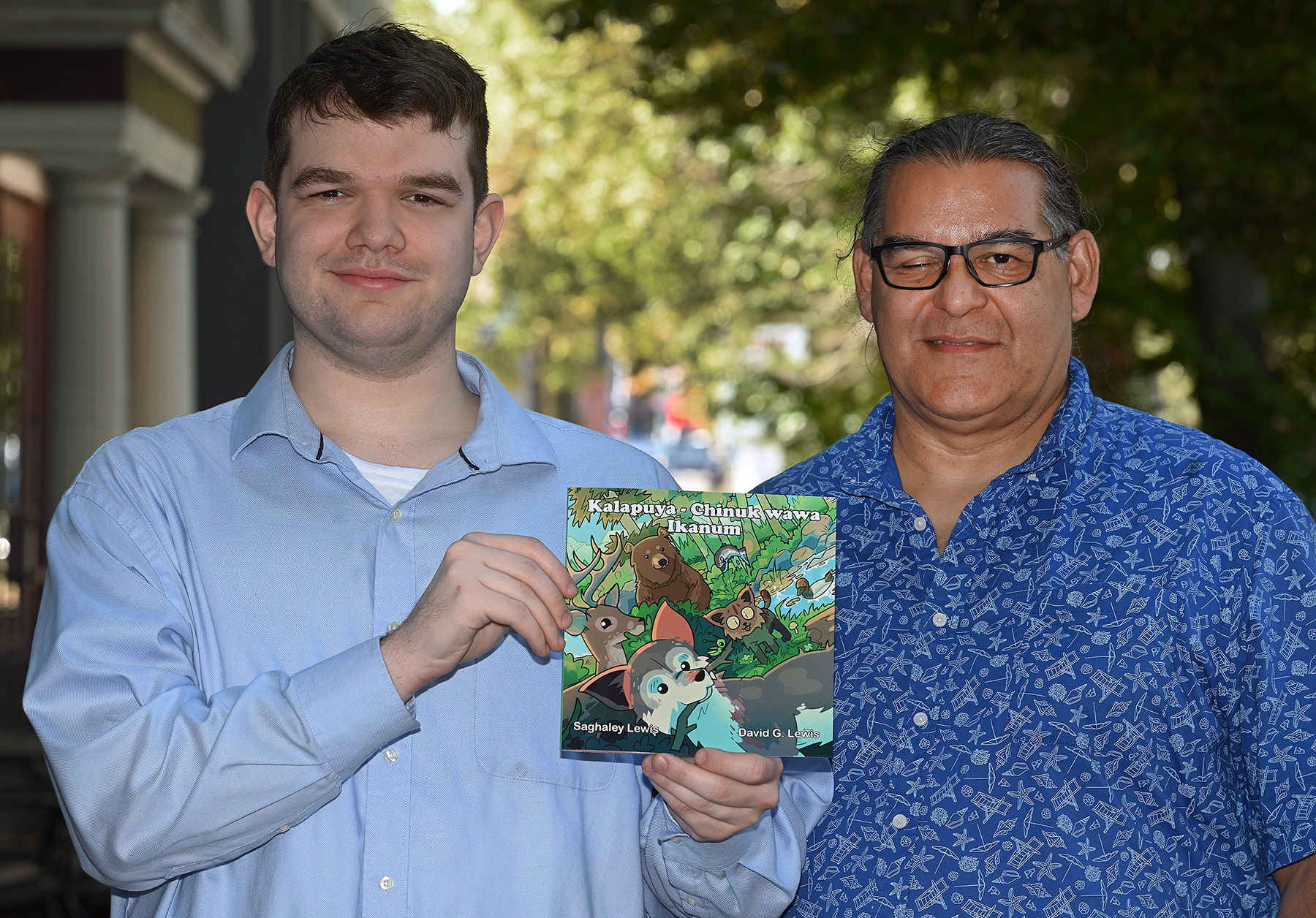
A new children’s book by Tribal Elder Dr. David Lewis and his son, Tribal member and graphic artist Saghaley Lewis, provides a selection of names for various plants and animals, in both Kalapuya and chinuk wawa, as well as English.
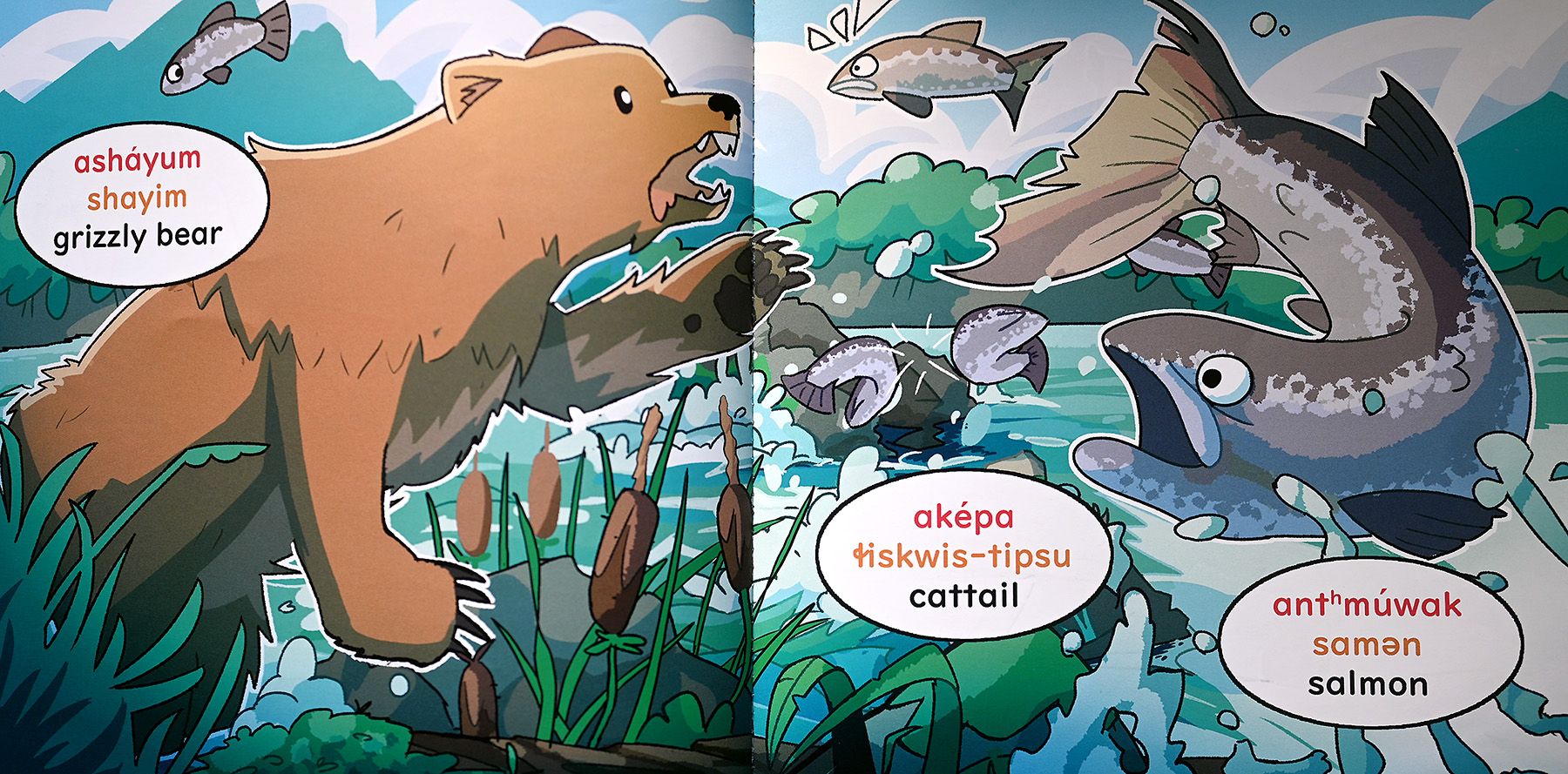
“Kalapuya – Chinuk wawa Ikanum” is a rare instance of a vocabulary book that provides words in three languages.
Although there is no story line to accompany the vocabulary words, the charming, funny illustrations make it easy for readers to imagine their own stories, as a fawn smells the fresh air, salmon nervously watch a fishing bear and a duck comes face to face with a sturgeon.
“I like when drawings have a little implied story, rather than characters just standing there,” Saghaley Lewis said.
The project took nearly two years from conception to completion.
“There was a lot of planning, a lot of thinking about what animals and plants to include,” David Lewis said. “I had to go and do projects to collect all of those names in different languages. I sent lists of things to Henry Zenk (an expert in Chinuk languages) and Greg Archuleta (Tribal Cultural Policy Analyst) for review, and they sent back comments on what they should look like, spelling-wise. … I think this may be the first volume that has Kalapuya and Chinuk in the modern era.”
The book also contains a short history of the languages and of the Kalapuya people, noting that the last speaker walked on in the 1960s. It notes that historically, Tribal members were multilingual and might speak as many as 10 different languages.
Today, however, Grand Ronde focuses on teaching Chinuk Wawa, while other Tribes have taken on preserving other Native languages.
Although he has been drawing for most of his life, Saghaley Lewis said he didn’t begin taking it seriously until after he graduated from college. This is his first children’s book, drawn in a manner that combines the popular manga style of Japanese comic books with cartoon imagery, that he said was inspired by the work of Spanish artist Carles Dalmau.
David Lewis said he was inspired by a set of books from the Cow Creek Tribe, which explored the Takelma words for various themes, such as colors and animals.
“So basically, I showed my dad illustrations and he gave me the idea; he gave me this book in another language that’s very similar and said, ‘Hey, do you want to do this, but with Kalapuyan words?’ I was like, ‘sure,’” Saghaley Lewis said.
David Lewis said he felt that his son’s style of drawing would appeal to children.
“There’s not a lot of Native art that’s produced like that. And then I think some of the language programs at Grand Ronde need additional materials, so it may or may not suffice for what they need in the Tribe,” he said. “Hopefully, I think parents will like it, a lot of Native parents have said they like it and they bought it for their kids. It doesn’t necessarily tell a story, but it does offer Native words and people can start making up their own stories using the images. There’s clearly something going on, whether it’s an eagle chasing squirrels or whatever. The design I like the best is the underwater sturgeon; it’s pretty cool. That’s been really popular.”
David Lewis said he has ideas for several more stories if his son decides to commit himself to the illustrations. Those might include more vocabulary words or even Kalapuya stories.
“And I’m not sure if we would try to write that story in three languages, that may be somewhat difficult, but it could happen,” he said. “There’s some pretty interesting ones out there, these stories have already been analyzed quite a bit by scholars and such, and they have really interesting figures in them. Some have monsters in them and giant elk or giant creatures with polka dots and horns and stuff. … We could go through the whole Kalapuya text and pull out a few good stories and do books on each one. It would be ambitious, but it could happen.”
David Lewis said he believes many of the ancient stories are actually history that has been passed down for hundreds of generations.
“Part of the problem has been that Native stories have been ignored over a long time,” he said. “They were collected 100 years ago or so and kind of studied for their linguistic character, but nobody really interpreted them as actual history. Now, we’re in this sort of new age, of people saying, ‘Well, wait a minute, maybe those stories are actual history.’ They’re events that happened in the time of the Tribes. We have pretty amazing stories that talked about flooding, volcanic action and tsunamis. And if that’s the case, … then it could be the case that the monsters they’re seeing are megafauna (large animals weighing more than 100 pounds).”
To order a book, visit the Quartux Journal at https://ndnhistoryresearch.com/shop/.
Additionally, the Tribe’s Natural Resources Department and Chachalu Tribal Museum & Cultural Center also purchased 300 copies of the book that it provided to the Tribe’s language program for distribution to students and families at the annual literacy night, Cultural Resources Manager David Harrelson said.