
 Current Issue PDF
Culture
Tribal members fulfill dreams of connecting with Tomanowos
By Nicole Montesano
Smoke Signals staff writer
NEW YORK CITY -- A trip to New York City to visit with Tomanowos was an emotional experience for Tribal Elders Pearl Boswell and Josephine Ingraham.
The two had originally won the drawing for the Tribe’s annual trip to the American Museum of Natural History in Manhattan for 2025. However, that visit was delayed for a year after the ceremony was abruptly canceled due to security concerns after the U.S. bombed nuclear sites in Iran, resulting in increased security in New York City and at airports nationwide.
This year’s trip took place from Tuesday, June 23 to Friday, June 26.
“I’ve been entering the drawing every year since becoming an Elder,” Boswell said. “I never, ever imagined I’d be called, but I kept entering anyway. I’ve wanted to see Tomanowos forever. I’m just so thankful. I’m just so grateful we were able to go and have that experience. It’s just sad that not all of our people will be able to do that.”
Ingraham said she was also excited to go on the trip.
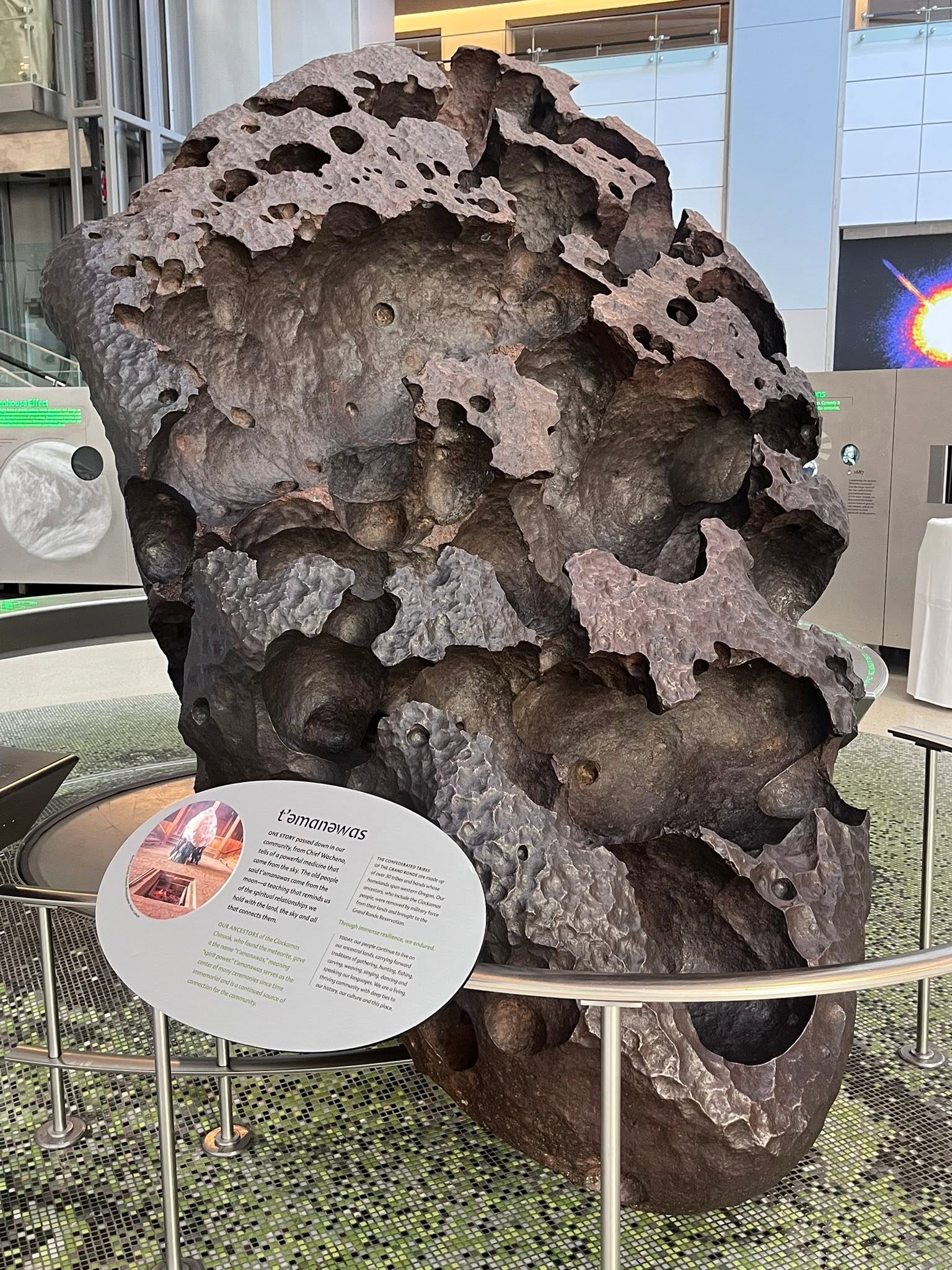
“I wanted to be in the presence of Tomanowos’ power,” she said, standing near the meteorite after the Tribe’s annual breakfast Thursday, June 25, with museum staff. This year, it was held in the Dorothy and Lewis B. Cullman Hall of the Universe, in the Rose Center for Earth & Space, with Tomanowos.
“It’s a melding,” Ingraham said. “I feel like I’m melding with it. I wanted to touch it, because I wanted to feel its power.”
Boswell said she suffers from severe social anxiety and agoraphobia, making the trip difficult for her. Her daughter, Tribal member Christina Morgan, accompanied her to make the journey easier.
“Being around so many people; it was kind of hard, but it was kind of a once-in-a-lifetime thing,” Boswell said. “It was actually one of the best experiences I’ve had…I did more walking in the few days that we were there than I have literally in the last three or four months.”
The annual Tribal ceremony with Tomanowos was led by Tribal Cultural Education Specialist Cristina Lara. She requested the details remain private.
In addition to Lara, the Tribal member and employee part of the delegation included Tribal Council member Tonya Gleason-Shepek, Family Support Specialist Santiago Atanacio, Communications Director Sara Thompson, Tribal Council Administrative Assistant Shannon Ham-Texeira, Member Services Manager/Veterans and CTGR Royalty Coordinator Shannon Simi and Social Media/Digital Journalist Kamiah Koch.
Tribal Elders Simone Auger and Jennifer Weiss also attended. Current and past Tribal royalty members in attendance were Senior Miss Grand Ronde Queen Marie Quenelle, Veterans Senior Miss Queen of 2024-25 Sophia Grout and Community Fund Intern Cheyenne Haller, who served as a museum intern in 2025.
Museum interns for 2026 were Merritt Langley, Ekias Sabin and Tidus Sabin, with Lara, Atanacio and Teen Pregnancy Prevention Coordinator Matt Bucknell serving as chaperones.
Smoke Signals staff in attendance were Koch and Staff Writer Nicole Montesano.
The delegation flew to New York on Tuesday and spent Wednesday exploring the city. On Thursday, the Grand Ronde delegation had breakfast with museum staff.
Museum President Sean M. Decatur welcomed the group, telling them that in March, he visited Grand Ronde to attend the annual Round Dance.
The experience, he said, “was an important reminder of the power of ritual, not just to bring people together, not just to strengthen bonds and generate new ones, but also to nourish the mind and spirit. This is the 22nd delegation from the Grand Rondes and museums, spanning our partnership of 26 years. This convening, indeed, this breakfast itself, has become a type of ritual of coming together that we repeat each year, that reinforces the bonds between our communities, that nourishes our relationship. It grounds us in remembrance of the harms of the past and of our commitment to build a different type of future together while moving forward, while also recommitting ourselves to continue the hard work to deepen and strengthen our relationship.”
Decatur noted that this year, the museum welcomed second-generation interns Ekias and Tidus Sabin, whose parents, Hope Lafferty and Eric Sabin, also served as museum interns.
“The museum has a painful legacy of both complicity and active participation in actions and decisions that have damaged Native communities,” Decatur said. “We not only acknowledge but work to learn from this past, continually improving and repairing, at times stumbling but always trying to become a true partner and friend to communities harmed in the past, by partnering to tell stories and to tell stories of the past while creating new stories for the future. And for 26 years, we’ve been honored to move together along this journey with the Grand Ronde.”
In their presentations to museum staff and the Tribal delegation during the breakfast, the three interns explored conflicting feelings about Tomanowos’ habitation with the museum, echoing mixed feelings among many Tribal members. The Sabin brothers took opposing sides, while Langley talked about how his feelings on the subject changed more than once over the course of his stay. All three said they had treasured their time in New York, the experience of spending time with Tomanowos and each other.
“I was told Tomanowos was taken away, all the way to New York, by just a man and a donkey,” Ekias Sabin said. “I was told I should be upset about it. But when I was accepted into this internship, I got to spend time with Tomanowos and time with this museum. I started to accept Tomanowos being here.”
However, he was disappointed by his observations of visitors to the meteorite.
“People were walking by all standing in big groups,” he said. “All standing there and talking to each other, but not a single person was looking at Tomanowos or reading any of the plaques. This made us wonder, how could we change it? How could we make people want to learn about Tomanowos? My answer to this question is, keep working with the museum to change things. People don’t interact with Tomanowos because they don’t know how to. They don’t know that they can touch him, they don’t know where he comes from. If people knew how much Tomanowos meant to others, we could share it. … I know in the future we will make Tomanowos so that everyone can be happy about it.”
Tidus Sabin addressed the opposite view, after a humorous account of his childhood view of New York.
“The Clackamas Tribe is not mentioned once in the entire archives. Not once,” he said. “It’s only about, ‘Is the meteorite going to make us a bunch of money’ or ‘We need the meteorite first before anyone else does.’ They don’t care about Tomanowos. They just care about the value. The money. Not why it’s important. If I could bring one thing home from this experience, it would be Tomanowos.”
Langley said his feelings remain conflicted. Initially, he said, “I wanted to get it back myself. I wanted others to see how important it was, not just to me, but the people around me.”
During his stay, he said, “I’ve learned a lot about Tomanowos that I hadn’t known before. I also learned how sympathetic the people are here and how they understand how we feel about getting Tomanowos back. I respect how they asked us questions about what we want and what we want to do with Tomanowos. I started to think that having Tomanowos stay here and having people learn about our culture, having them learn about our history, isn’t so bad.”
He continued, “But after I spent some time observing people and visit the museum, my opinion started to shift a little bit. People weren’t paying attention. I noticed people were on their phones, texting. I didn’t feel seen or heard. I didn’t feel Tomanowos was seen or heard. I want people to see Tomanowos and acknowledge our culture. It’s been incredibly conflicting to me these past few days. … As much as I love the idea of bringing Tomanowos back, I feel that not as many people will see or ever even hear about Tomanowos if it’s back at Chachalu, if we do bring it back. … And while I do think that we need to get Tomanowos home, until then Grand Ronde and AMNH’s collaboration is vital, and (so is) changing how people learn about Tomanowos. If we continue to work together, I believe that we could have Tomanowos noticed and acknowledged. Therefore, our Tribe and our people can be acknowledged, so that one day, everybody will want Tomanowos to come home.”
Haller said she experienced many of the same feelings during her own internship in 2025, with fellow intern Paisley DeLoe. Sitting with Tomanowos and DeLoe every morning during their stay, she said, sparked a feeling of connection with Tomanowos and concern for its ongoing care. She was able to feel some of that same connection this year. She said that she and DeLoe were able to make some changes to the museum’s website, replacing several instances where Tomanowos was referred to as “The Willamette Meteorite” with its name, as well as restoring the traditional chinuk spelling.
“Seeing it spelled correctly, I think is a good thing for our people,” Haller said. “It’s like reclaiming the identity of the meteorite.”
Today, Haller said, she believes the meteorite needs to come home and be with the Grand Ronde people, who she said can care for it in a way that the museum can’t.
“I’m in favor of keeping relations strong with the museum while it’s there,” she said. “However, I’m 100% that it needs to be here, with our people.”
She said she feels fortunate to have had the opportunity to visit it in New York.
“I think if you’re a Tribal youth or a Tribal Elder or a Tribal member, who has the opportunity to go see Tomanowos, you should take advantage to the best of your ability,” she said.
Tribal Council member Tonya Gleason-Shepek told the group that she hadn’t originally intended to join the trip.
“This is my first time to New York and it’s been a great experience,” she said. “I went out to lunch yesterday, met with the interns and went on a walk with the Royalty girls. Experiencing the city; it’s been great,” she said.
However, she added, “I was not going to come to Tomanowos, because my mom always wanted to come here and she wasn’t able to. She would tell me stories and tell stories about when all the lawyers and people from the museum would show up, showing up in Grand Ronde in their suits and how it felt like they were being invaded, and through all the negotiations that went on. She always wanted to come and she passed away a couple years ago and did not get to make it here.”
Visiting with Tomanowos earlier in the day, she said, “I was surprised, you know, how conflicted I felt.”
Gleason-Shepek said she felt happy “to see all the different people and different cultures” visiting with Tomanowos, but “also very sad, you know, that so many in our community will never get to see or touch Tomanowos. That physical connection makes the entire relationship that we have with him complete. And so, a lot of people will not have the connection, so it was sad too, but … I’m very thankful for everything you all have done.”
In particular, she thanked Lara and Atanacio for “your dedication and your love, bringing our people here and that connection.”
The group was graced with perfect weather during their stay. Elders and staff visited the 9/11 Memorial & Museum Wednesday, then walked together to the American Museum of Natural History for a breakfast of scrambled eggs and sausage Thursday morning.
A guided tour of the Allison and Roberto Mignone Halls of Gems and Minerals followed after which the delegation was taken backstage to hold a visit with the belongings for the first time in several years. At Lara’s request, the details of that visit are being kept private.
The delegation was also given tickets to explore the museum on their own in the afternoon, before returning for the ceremony with Tomanowos in the evening. The delegation flew home Friday morning.
Tomanowos’ history
Tomanowos is the iron-nickel core of an early planetoid that was formed and orbited the Sun millions of years ago. It was shattered, possibly in a collision with another proto planet. The core fell at approximately 40,000 miles per hour to the Earth’s surface, landing in southwestern Canada.
From there, it was carried by the Missoula Floods that carved out the Columbia River Gorge, coming to rest in present-day West Linn, in the Willamette Valley. The Clackamas Chinooks named it Tomanowos and revered it as a spiritual being that healed and empowered the people since the beginning of time. The rainwater that collected in the meteorite’s crevices and pockmarks served as a powerful purifying, cleansing and healing source for the Clackamas and their neighbors.
Tribal ancestors also dipped their spearheads into the crevices and pockmarks of Tomanowos to obtain spiritual strength before a hunt.
But the Native connection was broken when the Clackamas and other Tribes were removed from the West Linn area and relocated to the Grand Ronde Reservation in the 1850s.
With the Native peoples gone, Tomanowos’ story grew more complex and convoluted. In 1902, it was kidnapped by part-time miner Ellis Hughes, who moved it off land owned by Oregon Iron and Steel Co., and he charged people 25 cents to view it.
Eventually, Oregon Iron and Steel won a lawsuit to regain ownership of the meteorite, which was then purchased in the early 20th century by a wealthy New York City philanthropist who moved it across the country and donated it to the American Museum of Natural History, where it sat, waiting patiently for almost 100 years for its Native peoples to find it.
In 1999, the Grand Ronde Tribe submitted a claim to the museum seeking return of Tomanowos under the provisions of the 1990 Native American Graves Protection and Repatriation Act. The museum countersued and eventually the two parties reached an agreement that Tomanowos would remain in New York City provided that Tribal members had annual access for religious ceremonies and the museum sponsored an internship program for Tribal youth to spend two to three weeks working at the museum every summer. In-person visits and the internships were suspended in 2020, 2021 and 2022 because of the COVID-19 pandemic. In 2025, the internships were cut short and the ceremony canceled due to security concerns