
 Current Issue PDF
Culture
Book club supports caregivers and patients with dementia
By Nicole Montesano
Smoke Signals staff writer
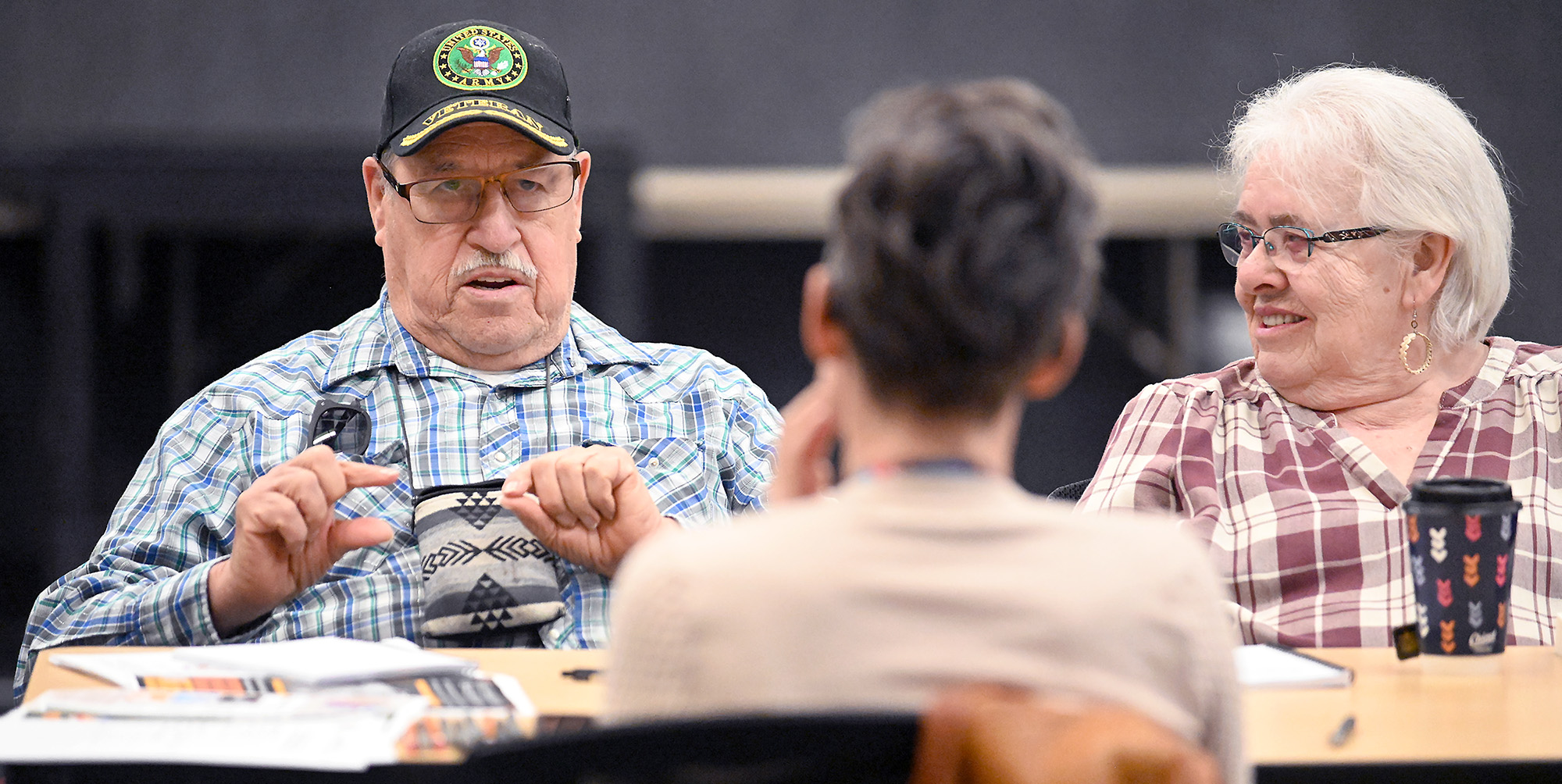
Fifty-four years into their marriage, Tribal Elder Ray Petite and his wife, Sally, are facing perhaps their biggest challenge. In September 2025, Ray was diagnosed with Alzheimer’s disease.
“He was concerned, because he’d been forgetting things, so he went in for testing,” Sally said.
After receiving the results, “The first thought that came into my mind was ‘what am I going to do, when he forgets who I am?’” she said.
Ray didn’t want to believe it.
“There’s a denial to it at first; ‘I don’t have that,’” he said.
Afterward, “We went home and turned on the music and danced to, I guess you’d call it our song,” Sally said.
In the weeks that followed, Ray dove into learning about the disease, while Sally called the Tribe’s Community Health program, looking for support.
She found it in the form of a new program offered by the Tribe’s Brain Health program: Mind Readers Brain Health and Story Circle.
Initially, Tribal Dementia Care Specialist Barbara Worthington said the group was envisioned as a supportive book club for caregivers. However, Ray wanted to participate.
“It’s grown into something much better,” she said.
Now, caregivers, spouses, patients and family members are all welcome.
“It changes your life,” Sally said. “It helps you get ready.”
Ray has faced his diagnosis head on.
“I think it’s made me more considerate of other people,” he said.
The couple agreed to tell their story to help others see that they aren’t alone and that support is available.
“I acknowledge that I’ve got it,” Ray said. “A lot of people don’t.”
He said he wants more people to try out the book club.
“I think people would benefit,” he said. “It gets them prepared, even if they’re not (yet) diagnosed with it. People confuse dementia with old age, but that’s not right. It can affect anyone; young, middle-aged, old – and it’s always there. (But) you might not see it for 20 or 30 years.”
Ray reads the books for the club along with Sally. They discuss their reactions and talk about how things are going at home. There are tears sometimes.
As they discussed a short story titled “I yelled at you today,” Worthington said it hit home for her, bringing back memories of the times she felt she had fallen short as she cared for her grandmother.
“Many times, I didn’t hold it together,” she said.
It hit home for the Petites as well, with Sally acknowledging they’d had “a tough morning.”
“He was yelling at me,” she said.
Sally acknowledged that she too sometimes loses patience, as she reached for a tissue to wipe her eyes.
“I worry about that,” she said. “I should be patient and say, ‘He has dementia.’”
“It’s hard,” Worthington told her. “You can just say that to him; ‘It’s hard today.’”
Ray said he can’t always keep up the way he used to. “She said, ‘You don’t hear me. I said, ‘Yes, I do hear you. I’m slow responding,’” he told Worthington.
It can take longer for people with dementia to process questions and answer them, Worthington noted, and it’s important not to rush them.
“It takes time,” she said. “If it takes too much time, re-phrase the question and keep it short.”
For the May meeting, the group had been going through the book “Chicken Soup for the Soul: Living with Alzheimer’s & Other Dementias,” by Amy Newmark and Angela Timashenka Geiger.
“It goes through the phases each caregiver faces … how they face it and we see how it affects people and what to expect,” Ray said, saying he finds that helpful. “I’ve learned a lot. I see, I’m at this phase now; here’s what’s coming up and how do I prepare for that. I’ve got a lot more understanding.”
Moving on to another chapter of the book, Ray read aloud for the group a list of the ABCs of interacting with people who have dementia. He and Sally agreed they’d like to have a printout of the list to put on their refrigerator.
Among its suggestions – never argue with the person, follow their lead, let them tell the same stories over again or keep washing the same dish.
They paused to discuss the suggestion to tell fibs if necessary – if, for example, the person is insisting they must drive to pick up a child who has long been grown – rather than upsetting them with the truth.
“Did that bother you? For some people, that’s a hard line,” Worthington said.
“For me, I think that’s a hard line,” Ray said.
“I think sometimes it’s going to be necessary,” Sally said.
For now, she said, “I tell Ray, ‘Don’t worry about it; I’ve got it.’”
Worthington asked if the technique helps.
“Oh, yeah,” Ray said. “’Cause I worry a lot. I try to take responsibility for what I do.”
Sally said she wants to keep Ray at home as the disease progresses for as long as possible.
“The only way I would let someone take him is if he got angry and violent,” she said. “But I don’t think he would do that.”
“I wouldn’t do that,” Ray said. “I like to walk away, to calm down. Like this morning, when she said, ‘You’re yelling.’ Ok, I’m going to walk away; that’s what helps me calm down.”
Worthington said there are other techniques that might help as things progress, such as modeling calming behavior, noting Sally’s earlier observation that Ray often imitates her or repeats what she has said.
“So, if you take a breath, he’ll probably copy that,” Worthington said.
The book group meets at the Chachalu Tribal Museum & Cultural Center gym, 8720 Grand Ronde Road, from 10 to 11:30 a.m. and from 3:30 to 5 p.m. on the first and third Tuesday of each month, to give members more flexibility with their schedules.
New members are welcome. To learn more, call Community Health at 503-879-2078.