
 Current Issue PDF
Tribal Government & News
Thinning planned for Memorial Landing site
By Nicole Montesano
Smoke Signals staff writer
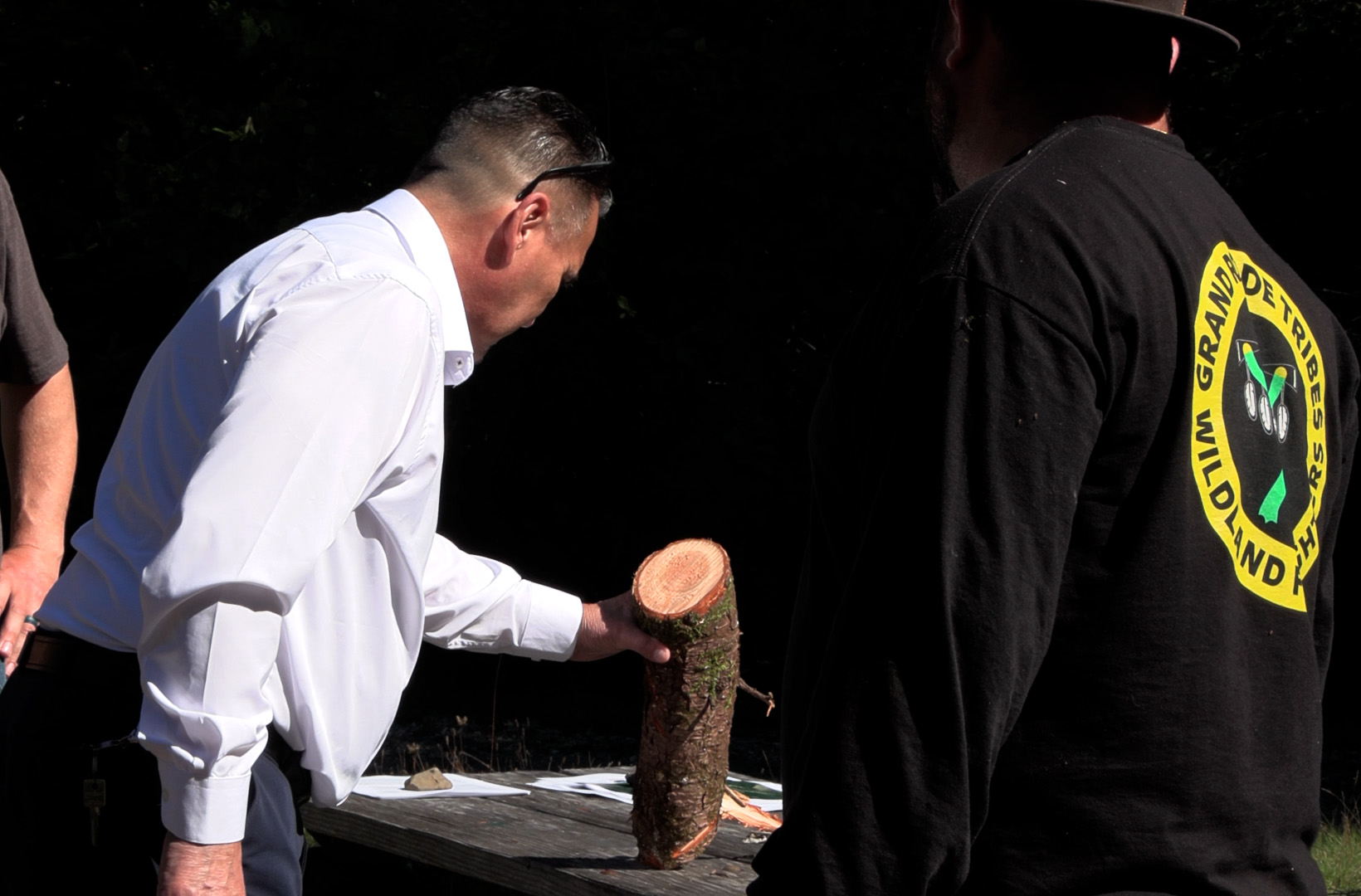
The Tribal Natural Resources and Cultural Resources departments are seeking comments on a plan to thin a cherished site on the reservation, called Memorial Landing, to reduce fire risk and create a healthier, more diverse forest. Toward that end, they held meetings Monday and Tuesday, Oct. 5-6, to explain their plans, though few Tribal members attended.
Tribal Council member Toby McClary attended the presentation Monday and council member Pete Wakeland was at the Memorial Landing site Tuesday.
Tribal Timber Resource Program Manager Travis Trammell, Tribal Historic Preservation Office Manager Briece Edwards, Tribal Archeologist Jeremy Johnson and Tribal Fire Management and Protection Program Manager Andrew Puerini explained that the much-loved site is the result of a Douglas fir plantation, in which trees are closely planted together, with little regard for either long-term spacing or biodiversity.
Now, the Tribe plans to move the site out of commercial timber production and “into a safe space for all the activities that go on up there,” Johnson said. At the same time, Tribal Natural Resources Department employees need to thin the site.
Without thinning, Trammell explained, there will be a higher risk for wildfire, disease and trees being blown over by high winds. Once the work is completed, it won’t need to be done again for a significant amount of time.
The group is working together, they said, to ensure that the thinning is done with care not to disturb existing memorials or remove trees that are being used for cultural practices. Trees will be carefully selected, with much of the work done by hand with chainsaws, rather than the large machines typically used for commercial timber falling. Crews will focus primarily on removing crowded Douglas fir, Trammell said. That work is also expected to open up more of the site for future use for memorials.
“We want this to be available for a long time, for families to use for memorial sites,” Trammell said.
He noted that the removed trees could be chipped onsite and the resulting mulch used for paths or made available to Tribal members to use at their memorial sites.
Puerini said the group plans to schedule a demonstration thinning of one small section away from the memorials, tentatively next fall, to allow Tribal members to see what the project would look like.
“The trees will respond quickly,” he said, “And the limbs will be touching in five or 10 years.”
The work is expected to more than double the area available for memorial sites, Edwards said.
Natural Resources has work scheduled during the next year to thin some of the stands near the Memorial Landing site, Trammell said.
McClary told the group that he initially had concerns about the project, but after hearing more about it, now feels confident that it will go well.
The group discussed the possibility of bringing in youth crews or others to help keep the site clean and of possibly eventually building a restroom and a gate to keep non-Tribal people out of the site. Edwards noted, however, that requests need to come from the community.
Puerini said the Tribal community will be notified about the demonstration project ahead of time, so they can temporarily remove any memorial items they are concerned about, observe the work or express concerns.
Questions or comments about the project may be directed to Jeremy.Johnson@grandronde.org or Travis.Trammell@grandronde.org.