
 Current Issue PDF
Tribal Government & News
tumwata village project moving rapidly
By Nicole Montesano
Smoke Signals staff writer
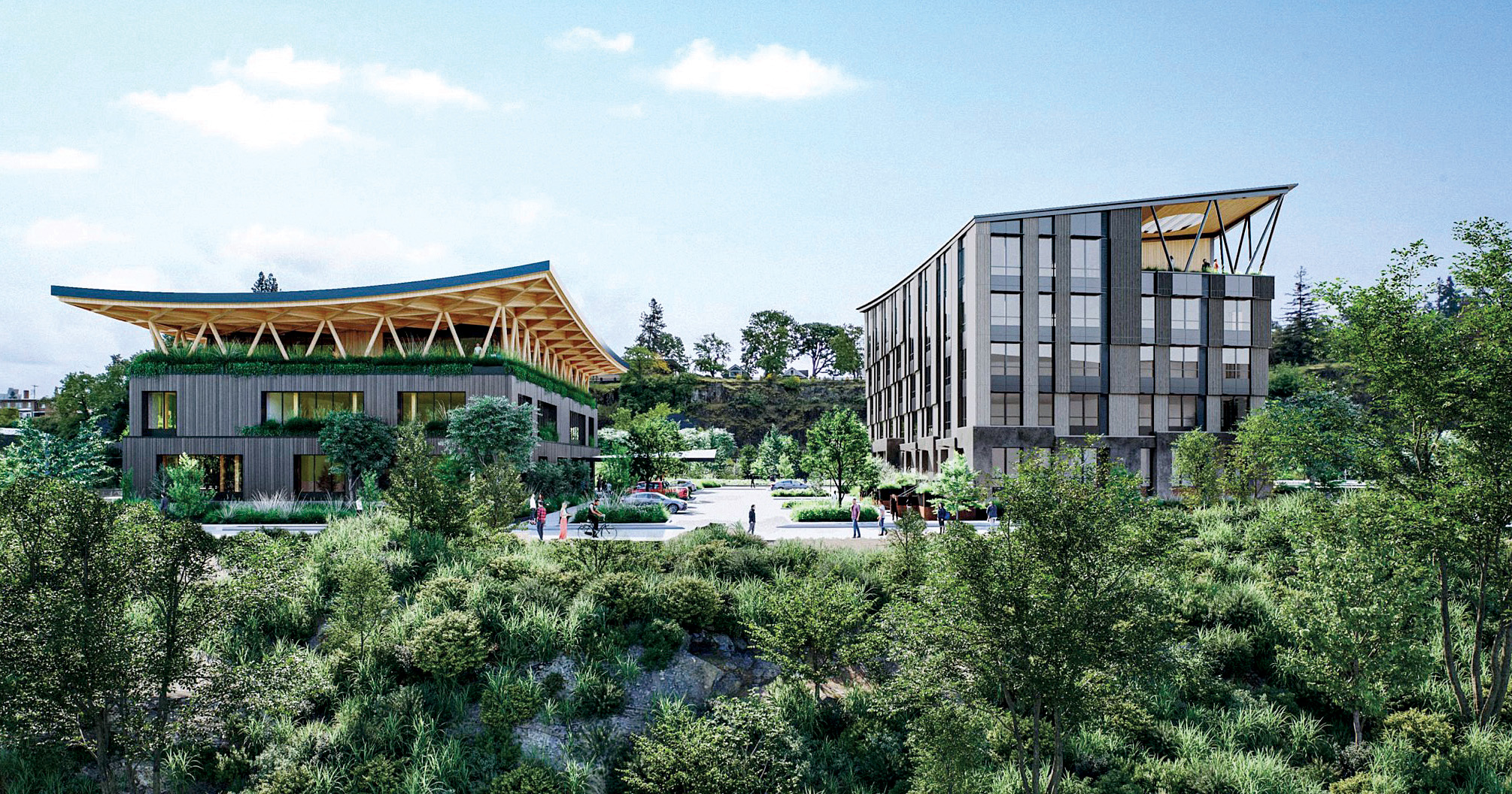
PORTLAND – After several years spent removing more than 40 of the 55 buildings left onsite by previous mills and enormous amounts of work to locate and remove or remediate underground storage tanks, the Tribe’s dream for tumwata village is moving forward rapidly, with the first section expected to open next summer.
On Thursday, Sept. 10, Tribal Engineering & Community Development Department Manager Ryan Webb and Tribal Community Development Manager Kristen Svicarovich gave a presentation to the Portland Metro Council to provide a project update and to ask for $20 million for the third phase of the project, blocks three and four of the river walk.
The Tribe broke ground this summer on block one of what it intends to be a “modern Tribal village,” Svicarovich and Webb told the Metro councilors and construction is expected to be completed by June 2027. It will include 55 housing units and the first section of the riverwalk. Block two, which includes 85 housing units and the second section of the riverwalk, is in design, with ground breaking expected in summer 2027. The Tribe hopes to put out a call for bids on the design work for blocks three and four in June 2027, Webb said.
Metro councilors voiced enthusiastic support for the project and said they intend to award the requested $20 million this fall.
The Tribe is working closely with Oregon City, through an intergovernmental agreement and a joint advisory committee. The intention is for the Tribe to retain ownership of the land, but for Oregon City to operate and maintain the site, through a permanent easement, Scott Archer, parks and recreation director for Oregon City, said during the presentation.
Svicarovich noted that partnership was beneficial for both parties.
“It works out tremendously well, because the city has the skills and expertise to maintain and operate it on a daily basis, because it’s up in Oregon City and the reservation is out in Grand Ronde,” she said. “Grand Ronde has the ability to maintain the ownership of our ancestral homelands, which is tremendously important and it is a really wonderful partnership.”
Webb said it is “very much a collaboration between the Tribe and the city.”
“We’ve done a lot of work to date, not just related to this project but to the whole site in general and it’s been an exciting partnership and we’re really excited about what we can do as it relates to the public riverwalk project as well,” he said.
Part of the work for the third and fourth blocks will include removing 130,000 cubic yards of contaminated soil that was used to fill channels of the river. The restored channel will provide “critical slow-water refuge” for threatened salmon and steelhead, as well as habitat for Pacific lamprey, Svicarovich said.
“I think that is a tremendous amount of focus of that healing and restoration onsite, and it’s ensuring that we’re caring not only for the people that walk on the site but also our relatives that are in the waters and throughout our region,” she said.
In addition, the restored channels will include approximately 32.55 acre feet of flood storage and improve the watershed function, she said. An acre foot refers to the volume of water it takes to cover an acre of land a foot deep in water. Thirty-two acre feet would total more than 10.6 million gallons of water.
A raised walkway will enable people to look down at the restored channels below, as well as see Willamette Falls.
The Tribe purchased the 23-acre tumwata village property in 2019, but plans for the riverwalk have existed since 2013, when the Willamette Falls Legacy Project first put it in a transportation system plan, Svicarovich said. Last year, the Tribe updated what is now the tumwata village Master Plan, significantly reducing the total square footage of buildings on site, explaining the plan to restore filled-in river channels and connect to other nearby trails.
The $20 million Metro allocation will be from the 2019 Parks and Nature bond that Metro voters approved, which specifically named the riverwalk as a possible beneficiary.
Metro Councilor Kristen Lewis said the Tribe’s presentation “went above and beyond our wildest dreams.” Several other councilors also expressed enthusiastic support for the project, with Councilor Gerritt Rosenthal saying the falls are “the crown jewel, part of a whole effort to reimagine the whole river as a living system.”
The Tribe is also continuing its demolition work of the remaining buildings.
“The 25% we have left is the more complicated and complex ones left as they are located either close to the river or they have a lot of hazardous materials (such as) asbestos and lead paint,” Webb said. “But we have plans to continue demolition activities through this year and next year and hope to have the majority of those structures down by then.”
In addition to the funding from Metro, the Tribe has a “soft commitment” for $500,000 from Business Oregon and is seeking a $15 million grant from the National Parks Service, Webb said.
In addition to telling the story of the Tribe’s history at the falls, Svicarovich said, the Tribe is also working with other people of color to enable them to tell their stories.
“Of particular importance for the Tribe is the connections that we’ve been building with … communities with historic connections to tumwata village, so Oregon Black Pioneers, Oregon Chinese Diaspora Project and the Hawaiian Civil Club,” she said. “We know there were many communities that have historic connections to places that now live in a diaspora throughout the region and so we want to ensure that those communities have a place and ensure that their stories are also told and incorporated onsite.”
In addition, Svicarovich said, “this is part of a larger regional trail system and transportation is a huge part of this project. This project will provide an ADA accessible route along the falls, an extension of downtown taking people closer to the falls. The intent was always that you would have this progressive experience as you got closer to the falls and we’re able to do that as we extend the trail closer to the falls, the riverwalk.”
The riverwalk will also connect to the potential Oregon City-West Linn bicycle bridge across the river, the McLoughlin Boulevard enhancement project in Oregon City, the Trail to Canemah and the existing promenade, which will include a new elevator.
Tribal Council Vice Chair Jon A. George and Tribal Council member Kathleen George attended the meeting, where they presented beaded necklaces to Metro councilors who were present in person.