
 Current Issue PDF
Tribal Government & News
Disaster Response Committee focuses on building a strong community
By Nicole Montesano
Smoke Signals staff writer
Making a difference after a disaster often consists of surprisingly small steps to tackle what otherwise look like overwhelming problems. The Grand Ronde Community Disaster Response Committee is busy laying the groundwork for those steps, focusing on how the people of Grand Ronde, Sheridan and Willamina can come together to build a stronger, more resilient community.
A winter storm can knock out power for days or weeks, leaving families struggling to meet basic needs, or a wildfire could roar through a community, leaving devastation in its wake. Then, there’s the Cascadia Subduction Zone earthquake expected to hit the Pacific Northwest at some unknown time.
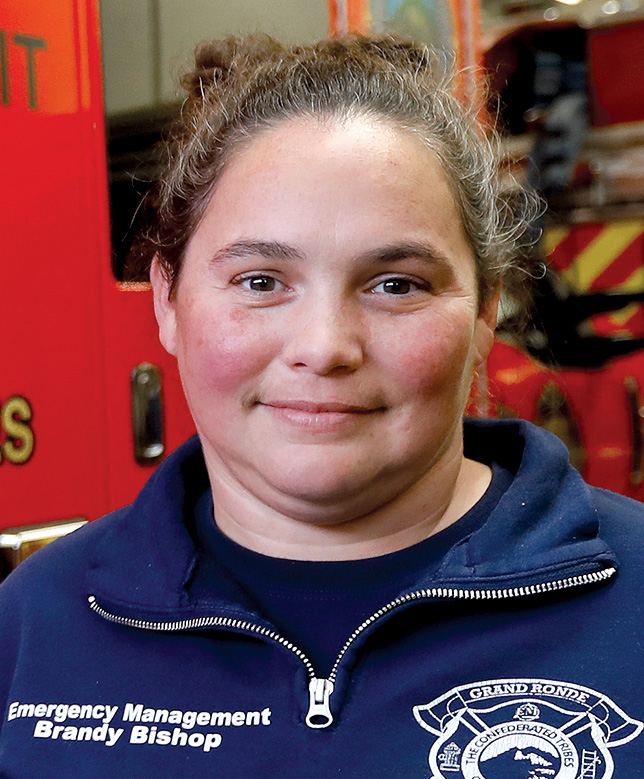
A prepared community is a resilient community. Tribal Emergency Preparedness Coordinator Brandy Bishop and Resilience Officer Kaylene Barry are working on improving the resilience of Grand Ronde, Sheridan and Willamina. They are seeking more participants on the CDRC, which meets at the Willamina Fire Station on the last Wednesday of every month at 6 p.m., and the Grand Ronde Fire Station on the last Thursday of every month at noon. However, because of the holiday season, for the next two months, those meetings will take place Wednesday and Thursday, Nov. 18-19, and December 9-10.
“Community is the one of the most powerful protections,” Bishop said.
She said she hopes the teams the committee is building will also help build compassion, as people who might not otherwise know each other learn to work together, “building it small, and then letting it spread. We’ve got to have a strong foundation.”
It isn’t necessary for people to dedicate large amounts of time to participate in the committee.
“Even the smallest bit is good,” Bishop said. “Five minutes a month, where you do some research and you give us that information. Or you get CPR training.”
The CPR piece is crucial, she noted, as every trained person is another emergency first aid resource for the community.
One issue the meetings will address is what type of trainings people are interested in, Bishop said. People may want to focus on adding fire extinguishers to their homes and learning how to use them, learning how to preserve food or improving their household preparedness by stocking up on items like shelf-stable food, water and first aid supplies.
“Everyone has something to offer,” Bishop said. “We need to build resource lists and identify gaps. It’s a lot and it’s going to take time to get there.”
She hopes to offer activities over the next year or two for helping people learn to build emergency kits, stock emergency supplies, purify water, learn ham radio operation and other skills.
Communication is key during an emergency and so is advance planning. When roads are out of commission due to weather, fallen trees or earthquakes, people are likely to be stuck in their own immediate area for some time. The committee has mapped out 13 “islands” in Grand Ronde, Willamina and Sheridan.
“We’re trying to build out smaller committees in those zones of people who live or work there,” Bishop said. “Those teams figure out what resources are there and what aren’t, what’s needed.”
Since communication with people outside each zone will be a major issue, Bishop said, the committee is encouraging people to learn ham radio skills and may sponsor a class for those wishing to earn their license, to give the zones a way to communicate with each other and with the emergency command center. That way, it can determine where the most need is at during a disaster.
For more information, contact Barry at 503-879-1701 or kaylene.barry@grandronde.org or Bishop at 503-879-1837 or brandy.bishop@grandronde.org.