
 Current Issue PDF
Tribal Government & News
Coming home to tumwata
By Nicole Montesano
Smoke Signals staff writer
OREGON CITY -- It’s been a long journey, but the people of tumwata falls are finally coming home, Grand Ronde Tribal Council Chairwoman Cheryle A. Kennedy told the crowd assembled Thursday, May 29 at the Tribe’s tumwata village property.
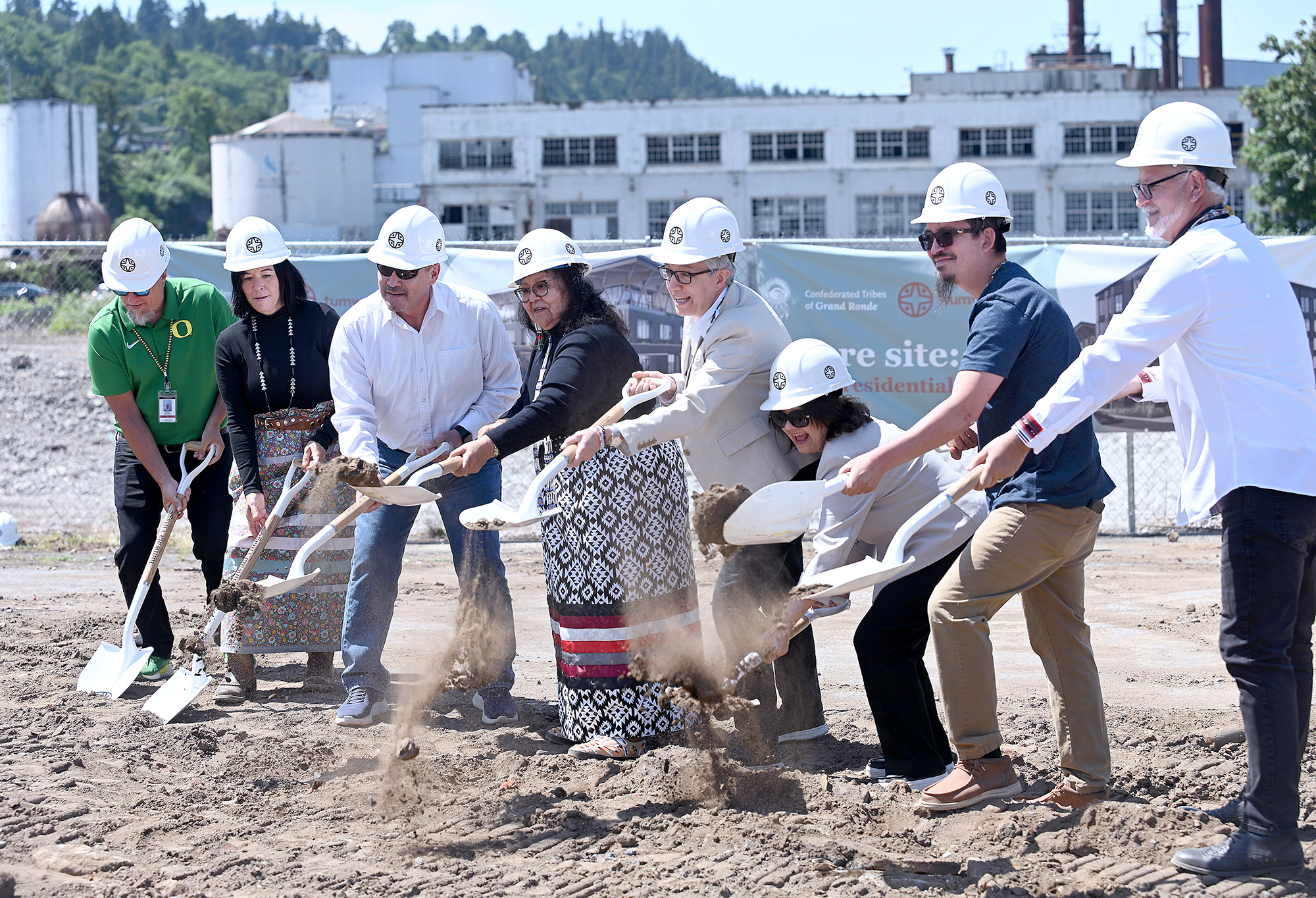
Tribal members, dignitaries and staff from various city and state agencies gathered in Oregon City to break ground for the new community and Tribal gathering place, located at the former Blue Heron Paper Mill.
“Today, we start rebuilding,” Kennedy said. “Today, we lay the foundation of tumwata village and start the process of bringing our people back to the falls, as well as everyone else. This place is a sacred place. This has been a long time coming, but we are home today."
She told the crowd that she is descended from Clackamas Chief Daniel Wacheno, one of the signers of the 1855 Willamette Valley Treaty and called out Tribal Council member Lisa Leno and Tribal Cultural Policy Analyst Greg Archuleta, who are also descended from Clackamas treaty signers.
“I know our ancestors are here watching,” Kennedy said. “Their hearts are full as they encourage us to move forward. It was our grandpas that stood here and who did this work, and they would have been welcoming you. Now it’s passed on to me to welcome you in the same spirit.”
In addition to Kennedy, Tribal Council Vice Chair Chris Mercier, Secretary Jon A. George and council members Matthew Haller, Lisa Leno and Pete Wakeland also attended. George gave the invocation and served as emcee. Grand Ronde singers drummed and sang.
The Tribe has spent several years demolishing unsafe buildings and removing contaminants and items, including buried railway tanker cars and fuel tanks from the site since it was acquired by the Tribe in 2019.
Tribal Engineering & Community Development Department Manager Ryan Webb was hired to oversee the project, although his job has expanded significantly since then. But his focus has remained on tumwata, he said, calling it the most challenging project of his career.
“tumwata village is not merely a project; it is a promise,” Webb said. “A promise that this land, once taken from its original stewards and reshaped by industry, will once again rise in a way that reflects the people of this place, what they value, and what their future is. This work is for the generations to come.”
Kennedy noted that “Our work started in 2019 when we purchased the land and we will not quit until it is done.”
She pledged that “There is a welcoming place that we are building into our project here, a place where all Tribes will have a place to gather together. A place to come together and to share good ideas and thoughts, as over the past millennia our people gathered here. We were the keepers of the falls and we welcomed all Tribes. This was the biggest place of commerce west of the Mississippi for Native Americans to come and gather here and to fish.”
Just days earlier, the Tribe had caught its first fish of the year, dip netted from the rocks next to Willamette Falls. The Tribe is still waiting for a decision by a federal judge in a lawsuit filed by Portland General Electric, which is seeking to condemn and seize ownership of the falls. The outcome of that trial, which took place more than a year ago, will likely determine whether the Tribe is able to maintain access to its ceremonial fishing platform. Either way, however, the Tribe intends to make tumwata village a place where Tribal members and the public once again have access to the falls.
“It's less of a beginning and more of the continuity of the place,” Oregon Gov. Tina Kotek told the crowd. “Willamette Falls is one of the wonders of North America. Long before Oregon, this place was a gathering ground – a fishery, a trading center, a site of ceremony and kinship that drew Tribal nations from the coast, the valley, the Columbia and the Plateau. We are in a special place.”
Kotek said the first building “will be incorporating ground floor retail space that will anchor the southern end of Oregon City, West Linn, Clackamas County and the state of Oregon. … (It) will be an engine for local growth and regional growth. … it will … demonstrate that economic growth and environmental stewardship can truly walk side by side."
Kotek told the crowd that “This moment is about justice. It’s about recognizing that Oregon’s future is stronger when Tribal nations thrive, when ancestral lands are healed and when Indigenous voices are heard.”
Oregon City Mayor Denyse McGriff said the project “is an expanded concept to bring restoration and healing to this place. … As the vision unfolds, much like a flower opening petal by petal, tumwata village will make our lives and our city fuller and more fulfilling.”
Archuleta provided some of the history of the falls.
“They’ve asked me to kind of share a little bit about our ancestors’ place here, at the falls,” he said. “They gave me the most dangerous job of all; because they want me to tell some of our ikanum (chinuk wawa for story), outside of our ikanum time, so I risk being stung by a bee or dealing with a snake wrapped around myself. Hopefully I don’t tell too much and get in trouble.”
Archuleta shared with the crowd two stories about the origin of the falls.
“For the Clackamas people, we have the story of how tumwata was created, and how Coyote decided to build the falls at Oregon City here, and as part of that, he built a fish trap,” he said. “And that fish trap would keep producing fish. Coyote got tired of it and kind of insulted it, so they say that’s why we have to dip net here, instead of using a magical fish trap.”
The Hudson family, Archuleta said, “sent in a Kalapuya ikanum that tells also of the falls being created. Coyote and Meadowlark decided they were going to create a falls on the river and they started way, way, way, way up on the river and the falls kept moving down.
“Meadowlark said, ‘how about here?’ Coyote didn’t understand; he spoke Kalapuya; Meadowlark spoke the Clackamas language. And so the falls just kept moving down further and further. They got to Salem and Meadowlark said, ‘How about here?’ But still, he didn’t understand. So, the falls just kept going further and further down the river. And then finally, when they got to Oregon City here, Meadowlark spoke in chinuk wawa, and he said, ‘How about here?’ Coyote agreed, he understood, so they put the falls here in Oregon City and they tied it down with hazel.”
Archuleta noted that hazel is an important Tribal resource for basketry and other uses, as well as for nuts.
“So they used that to tie down the falls here and those hazel sticks turned into stone, so that’s where the falls are today,” he said. “The Santiam say that’s why the falls are in Clackamas Country, versus being in Santiam Country.”
Smoke Signals intern Alexander Bliven contributed to this article.