
 Current Issue PDF
Culture
MMIP walk draws 150 to remember, call attention to loved ones
By Nicole Montesano
Smoke Signals staff writer
Red and black clothing, sometimes marked with red hands, dominated Salem’s Riverfront Park Sunday, Aug. 30, with at least 150 people turned out for the third year of a walk organized by Ampkwa Advocacy to raise awareness of missing and murdered Indigenous people.
They walked in solemn procession behind the drummers and singers, four banners carried by young people that read “Missing, Murdered, Indigenous, Relatives,” and a Tribal Elder carrying a torch. A man dressed in all black carried a sleeping baby; women in ribbon skirts pushed small children in strollers.
Some carried signs: “Justice 4 Emily Pike! 14 years old;” “No more stolen relatives;” “Justice for MMIR; Not One More.”
Some were simpler: “Father;” “Brother;” “Wesley.”
“Prevention starts with awareness,” Ampkwa Advocacy Vice Chair and Tribal Elder Camille Mercier told the crowd.
She added that the key to the walk was “Not just grief but action. Not just remembrance, but responsibility. The most powerful thing we can do is not allow someone to become just another statistic.”
Tribal member Harris Reibach gave the invocation and played a flute song, followed by drum group Johonaaii, who played an honor song. Actor Chance Rush was the emcee and singer Isaac Tonasket gave a special guest performance.
Tribal Council Vice Chair Chris Mercier and Tribal Council members Toby McClary, Matthew Haller and Lisa Leno attended the event.
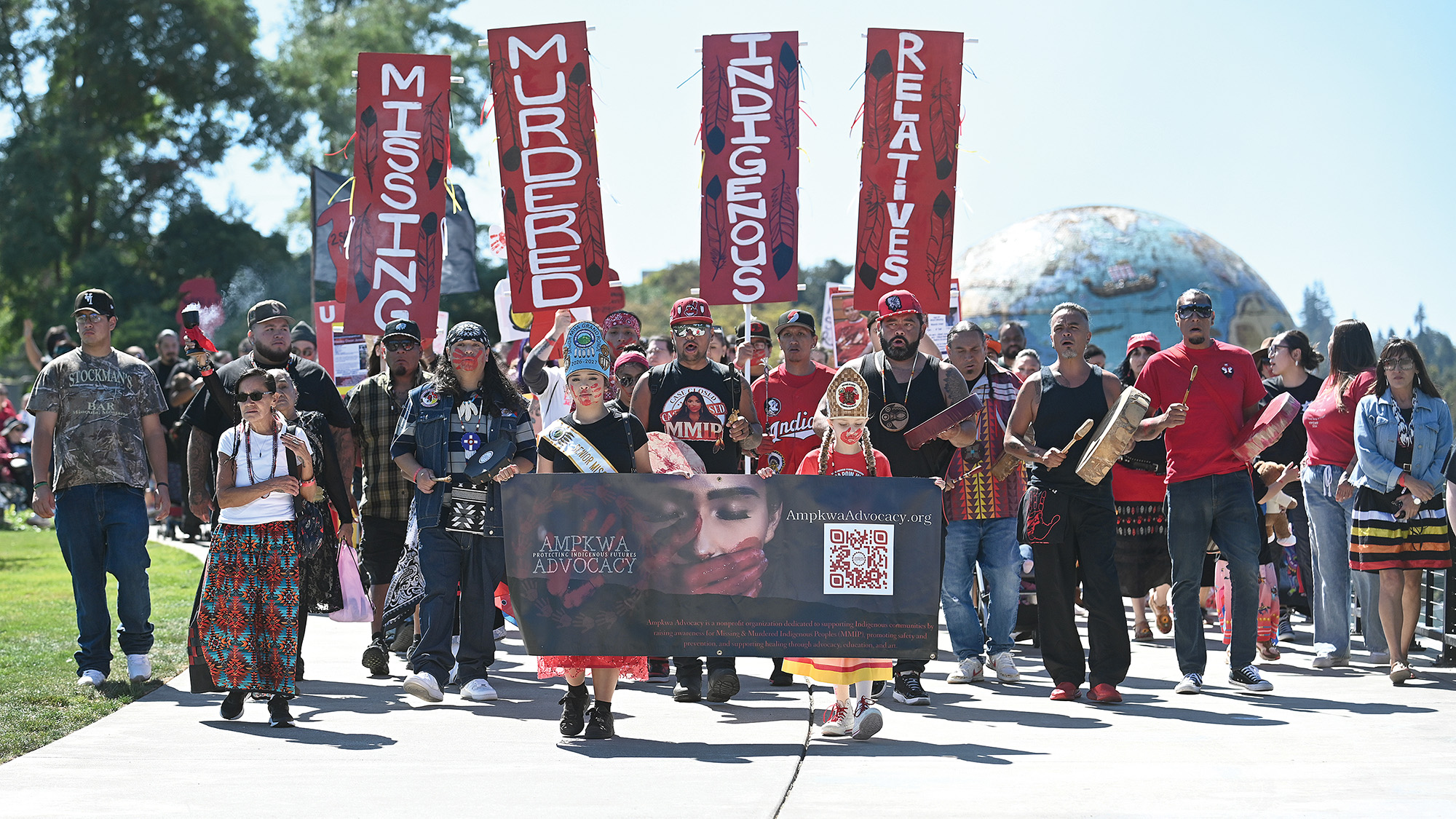
Tribal members Leloo Quenelle, 14, left, and Elizabeth Ulestad, 10, carry the Ampkwa Advocacy banner as they lead the nonprofit’s 2026 Missing and Murdered Indigenous People Awareness Walk at Riverfront Park in Salem Sunday, Aug. 30. Approximately 150 people participated in the walk. (Photo by Michelle Alaimo)
Tribal Elder Evelyn Quenelle said she had come to support Ampkwa Advocacy because of “murdered and missing children and families and people in the world.”
The Bureau of Indian Affairs website notes that a 2016 study by the National Institute of Justice found that more than four in five Native American and Alaska Native women have experienced violence, and that in 2023, homicide was the fourth leading cause of death among AI/AN men between the ages of 1 and 44, and the sixth leading cause for women in the same age range. Abductions and human trafficking rates are also higher than in the general population.
“MMIP is not just one issue,” Ampkwa Advocacy Founder and Chair Amanda Freeman told the crowd. “It’s the result of a lot of things that have been allowed to continue for generations: Colonization, violence, exploitation, child trafficking, jurisdictional gaps and systems that do not respond the same for everyone.”
The issue is deeply personal for Quenelle, as it is for so many Indigenous people.
“I’ve never gotten an answer to when my baby sister was found alongside I-405 in Portland,” she said. “I don’t know whether someone hit her and left her there, or she was placed there. That’s why I’d like to support other families.”
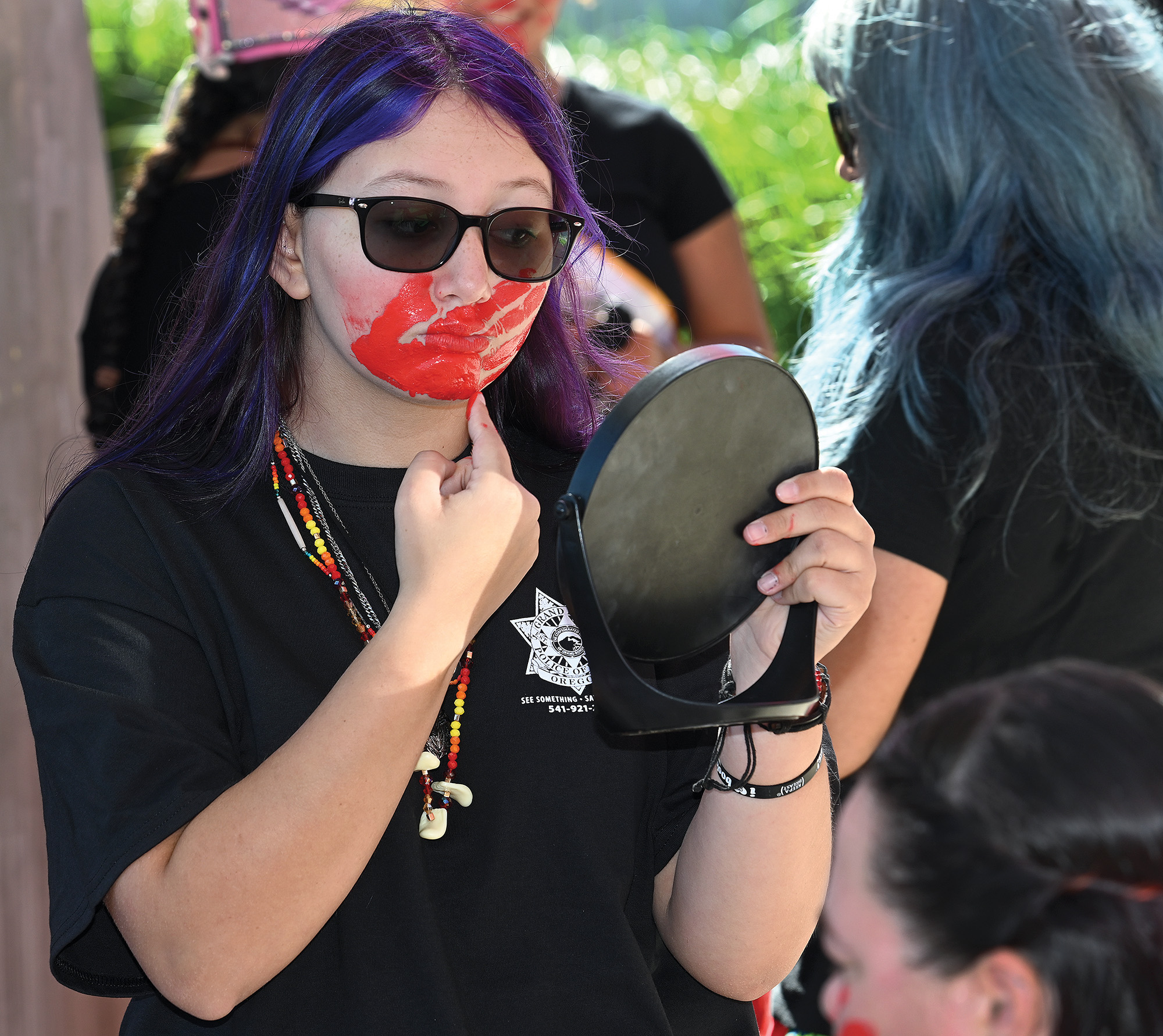
Quenelle, who wore a red and black ribbon skirt and later stood in line to have a red hand painted across her face – the symbol for MMIP – said she wants people to come together as a community and support each other.
“If you have someone missing, report it, so they can begin looking for them,” she said.
Chris Mercier said it’s important to draw the attention of the larger public to the issue.
“I heard about this event last year and I missed it because I was off camping,” he said. “It’s something that I don’t think registers in the general public because it’s so specific to Indigenous communities and the only way you’re gonna get the public to be more aware of it is by having events like this and inviting them to hear the stories.”
Much of the work of responding to a missing friend or relative falls on families, Freeman said.
“Families end up organizing searches, following up with agencies, getting information out, trying to figure out the jurisdiction, time or resources, advocating for their loved one and pushing for answers, while they are already scared or grieving or going through hell,” she said. “That should never be normalized, but it is.”
Freeman said the walk is important, not just for raising awareness, but for building relationships among individuals, organizations and agencies.
“The walk itself is not going to solve anything,” Freeman said. “But the relationships built here might make a difference later. A connection someone makes here today might become the person they call when a family needs something six months from now. A conversation that starts here might change the way something is handled later. Somebody may leave here understanding a part of this work that they didn’t understand before.”