
 Current Issue PDF
Culture
Tribe celebrates unveiling of First Fish Blue Herons
By Nicole Montesano
Smoke Signals staff writer
MILWAUKIE -- After more than 170 years, the herons are back on the Willamette River, calling the salmon and watching for their arrival.
Tribal Cultural Resources Department Manager David Harrelson explained to a crowd gathered by the Willamette River at Milwaukie Bay Park Saturday, April 18, that the Clackamas people would carve statues of blue herons and place them by the river to call the salmon to the people. When the first fish arrived and was caught, all fishing would cease for five days while the people celebrated.
That practice, like so many others, ended with settlement and the relocation of the Tribe to Grand Ronde after the 1855 Willamette Valley Treaty. A joint project with the city of Milwaukie and the Tribe is bringing the herons back to the river.
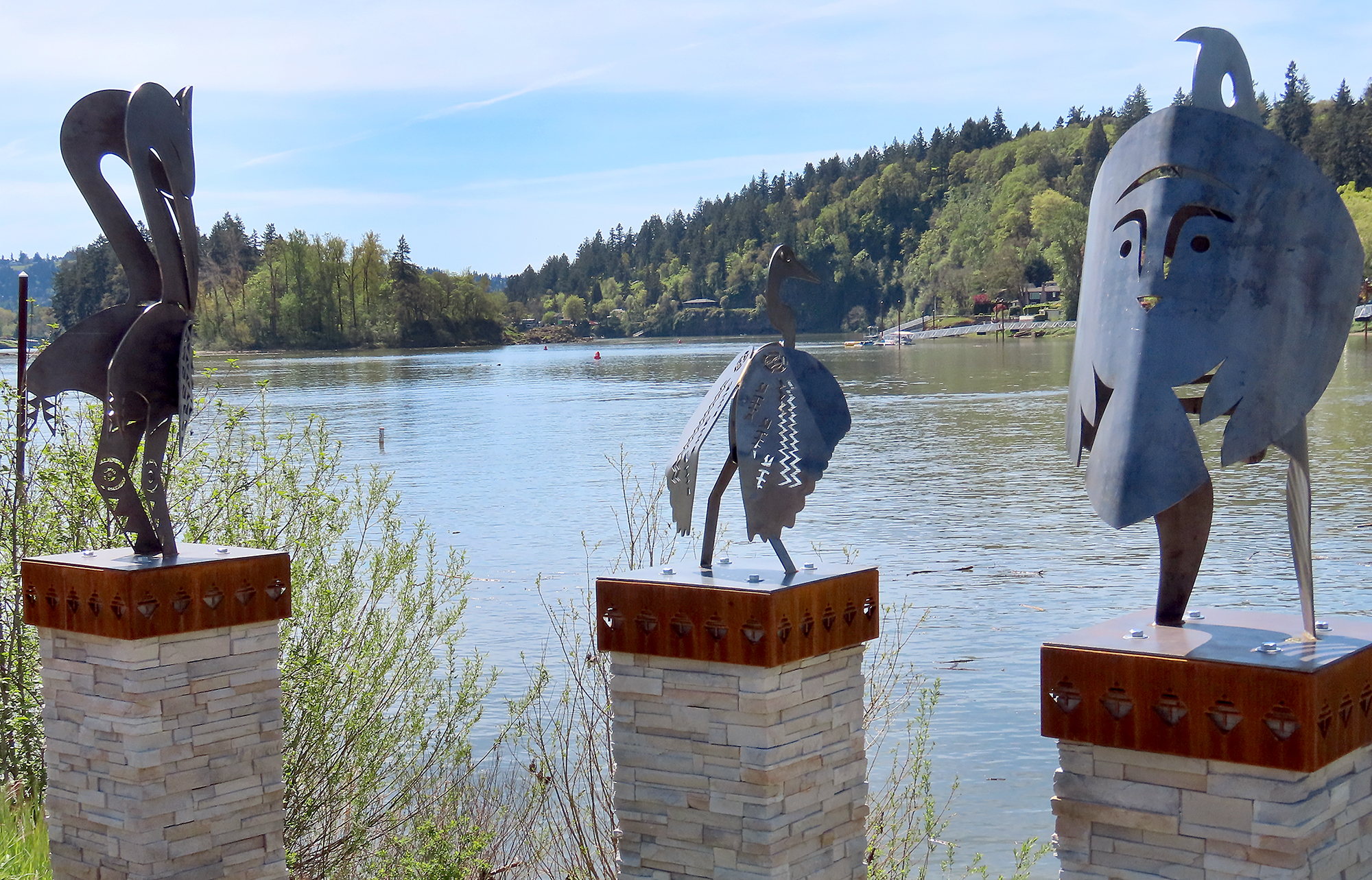
The city and Tribe held a celebration to unveil and dedicate three metal heron statues placed on stands overlooking the river at the park. They will remain through the spring Chinook season and then the Tribe will remove them. Each year, the Tribe will select three artists to design new herons for the spring salmon watch.
Tribal Council Secretary Jon A. George and Tribal Council member Kathleen George attended the event, along with members of the Cultural Resources Department and the Grand Ronde Canoe Family singers and drummers.
Milwaukie Mayor Lisa Batey, City Recorder Scott Stauffer and members of the city council also attended.
Harrelson told the crowd the project had its roots in a decision by the Tribe to submit suggestions for the Portland Monuments Project in 2020, to ensure it would include Tribal representation. Of the five ideas the Tribe submitted, Harrelson said, the First Fish Herons were selected.
The Tribe had been in contact with the city of Milwaukie previously, Harrelson said, as city staff sought suggestions for its waterfront redevelopment project but had offered few ideas other than the inclusion of native plants.
“We didn’t have anything concrete,” Harrelson said, until the First Fish Herons were created. “It dawned on us” that putting the herons along the river “would be perfect,” he told the crowd. The herons are intended “to remind people when there’s fish in the river and when the fish are not in the river, the herons won’t be there,” he said.
The metal sculptures were designed by Tribal members Bobby Mercier and Travis Stewart, as well as Tribal Elder Greg Archuleta. They stand side by side on pillars above the river.
As an eagle pursued a smaller bird above the river, speakers from the Tribe and the city discussed the partnership.
“This has been a six-year project,” Stauffer said, adding that the intergovernmental agreement with the Tribe was a first for the city.
Mercier and Archuleta both spoke first in Chinuk Wawa, then addressed the crowd in English.
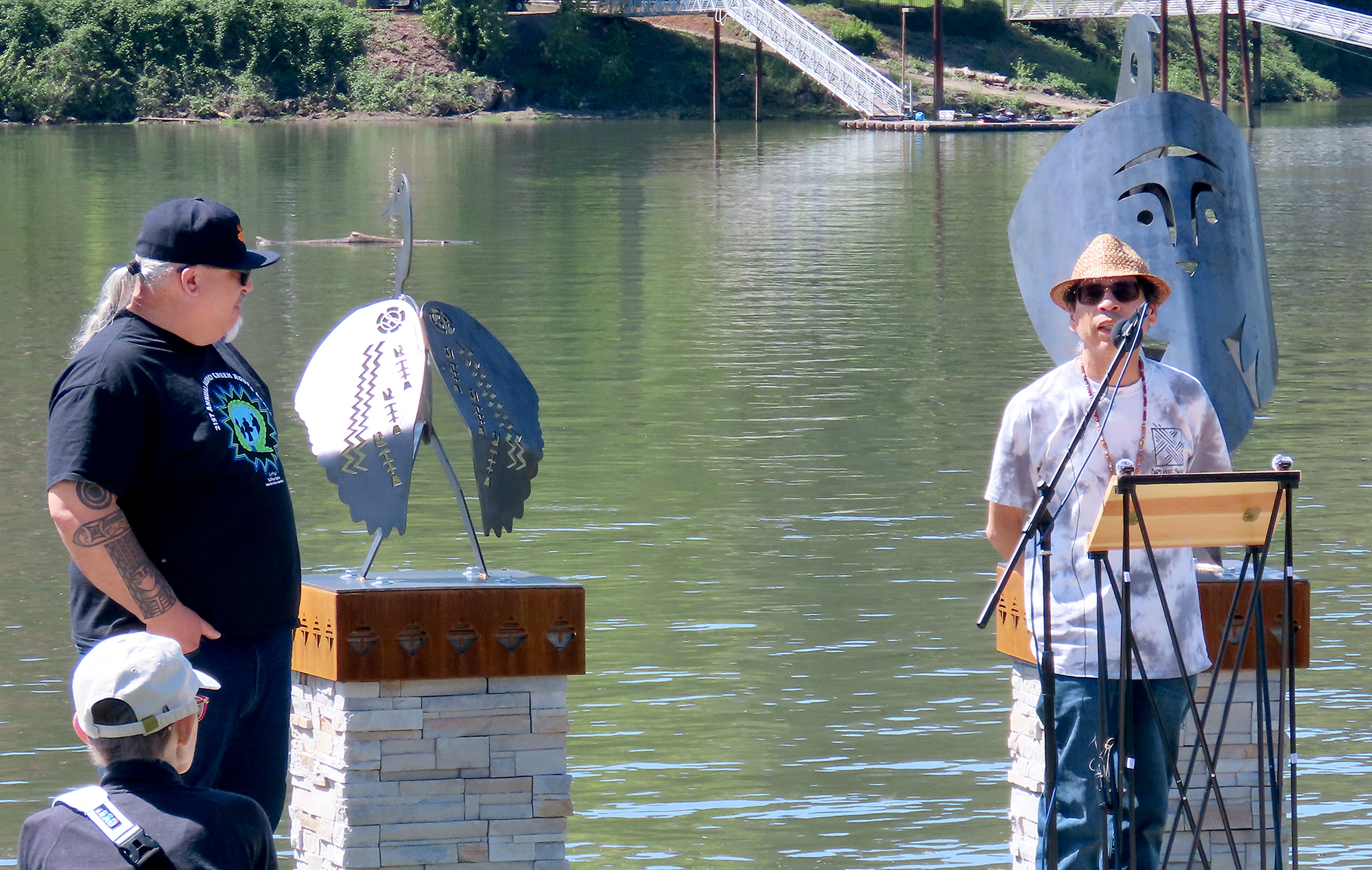
Tribal member and artist Bobby Mercier, left, listens as Tribal Elder and artist Greg Archuleta speaks during the First Fish Herons dedication at Milwaukie Bay Park Saturday, April 18. (Photo by Nicole Montesano)
Archuleta told the crowd he is direct descendant of chiefs who signed the 1855 Willamette Valley Treaty and other treaties.
“We have a strong connection to this place along the water,” Archuleta said. “According to the old stories, there would be a foot race among the youth, up on the bluff and the ones who won would put the five herons out. … A heron here is important in our stories … helping the people in different ways.”
Mercier said he is grateful to be able to return the herons to the river, after noting that many of the non-Tribal attendees did not understand the language Indigenous to the place.
Jon George told the crowd that “artwork is so important” to the Tribe that it is included in the designs and budgets for new buildings on the Tribal campus and pointed out that the work represents Chinookan tradition, rather than the more widely known Salish tradition.
In closing the ceremony, the Grand Ronde Canoe family performed a song about how the long-legged heron sometimes gets its feet stuck in the mud and must shuffle to work them free.