
 Current Issue PDF
Tribal Government & News
Wildland firefighting proves irresistible for some
By Nicole Montesano
Smoke Signals staff writer
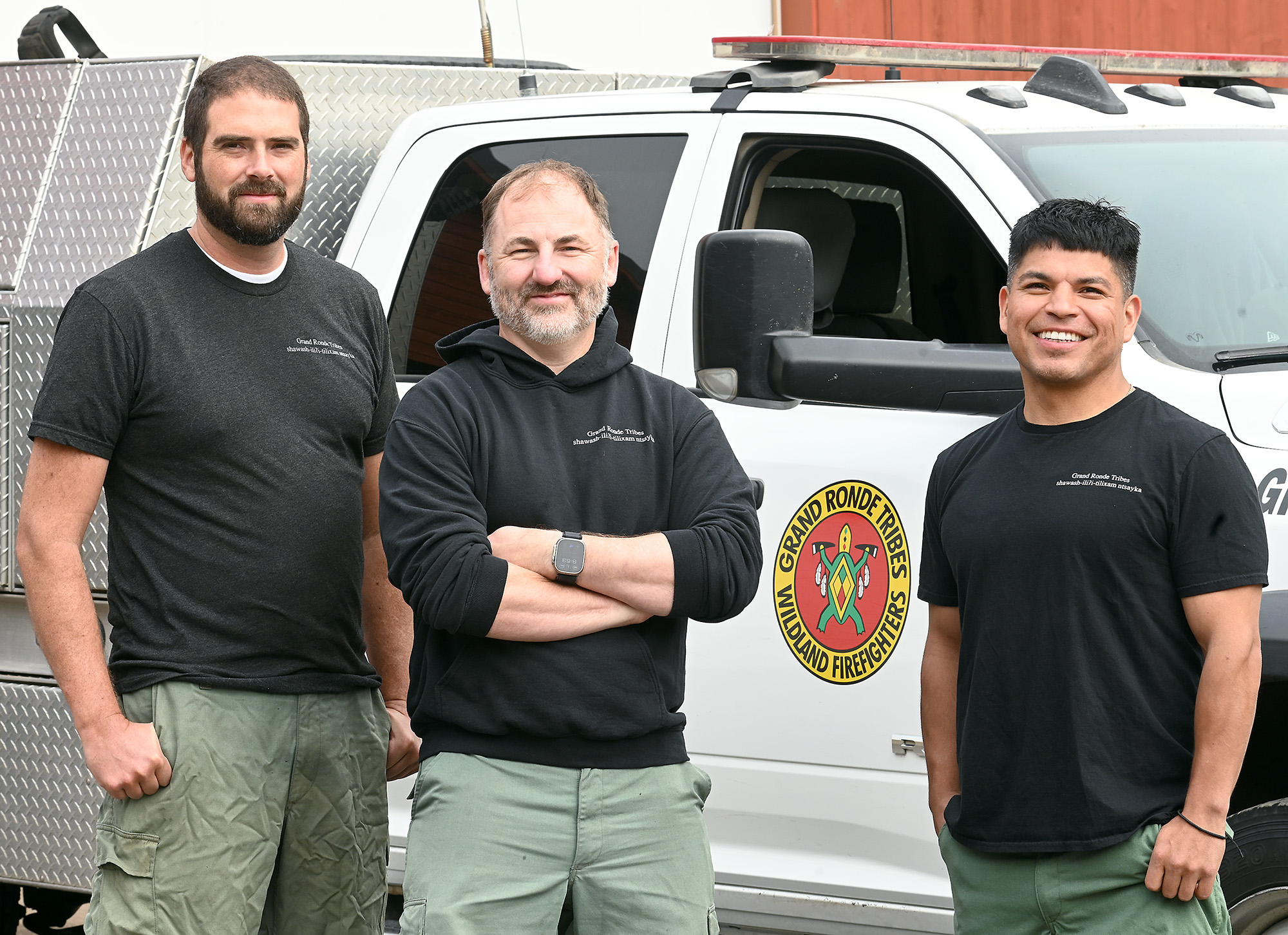
It’s hot, physically demanding, sometimes dangerous work, but wildland firefighting gets into the blood of some Tribal employees and keeps them hooked. There’s something about being out on a fire line, running a chainsaw, directing the helicopters dropping water and fire retardant or hiking through remote back country feeling stunned by its beauty. It keeps Tribal members Alex Drake and Dustin Hawks, and Tribal Tribal Recreation Coordinator Leo Ayala, coming back year after year.
Tribal Post-Secondary Education Coordinator Joshua Clift, another part-time wildland firefighter, was out on assignment when this article was written. A few other employees are working to earn wildfire certifications.
Drake, Hawks and Ayala all got their start as young adults in the Tribe’s seasonal wildland fire crew. Although they’ve moved on to other jobs within the Tribe, they still go out with the fire crews a few times each summer, with the approval of their supervisors, as their regular job duties allow.
There are a lot of reasons why they enjoy firefighting and one of them is simply that it’s fun, the trio said. A lot of elements are tied up in that idea of fun – the adrenaline rush, the camaraderie in the face of danger that often leads to lifelong friendships, the chance to be outside instead of behind a desk, the physical and mental challenges, the service to the Tribe and to the public affected by those fires.
“It’s honorable work,” Ayala said.
Ayala said he particularly enjoys communicating with helicopters, leading or directing them where to drop water or fire retardant.
“It feels like a mission that we’re all working together to get done,” he said.
Drake said he’s drawn to working on the front lines of the fire, called the hot line.
“Running a chainsaw cutting all the brush, with people digging behind you, that’s pretty exciting,” he said. “I like that. Or prepping a road so you can do a backburn if the fire’s coming toward it. Fighting fire with fire is a big tool.”
He added, “Getting out of the office a couple weeks at a time is good for my health, good for my mental well-being.”
The Tribe hires seasonal crews of wildland firefighters annually, as well as maintaining a full-time crew year-round. Many Tribal members now in other departments started in those seasonal crews. A few continue to take occasional assignments during fire season.
“While non-NRD wildfire support staff are not essential for daily program operations, they bring huge value,” Tribal Fire Management and Protection Program Manager Andrew Puerini said. “All our current volunteers maintain significant personal and program investments in training, certifications and experience. They find time in their busy schedules to assist with wildfire training, response, local patrols, prescribed burning and meeting other program goals.”
The Tribe also benefits financially, along with the firefighters, Drake said. When on assignment, employees from outside the Natural Resources Department are not receiving their regular salary, but are instead paid under the wildland fire program, which is reimbursed by the federal government.
“The Tribe’s now invested all this time and energy in my getting all those skills and experiences, like getting me able to drive an engine,” Hawks said.
All three said they typically go out on one or two assignments per summer, occasionally three.
“It gets me out of the office, out in nature, using a chainsaw or driving a truck,” Ayala said.
He loves the adrenaline rush of being called out, the travel to national parks and states he might never have otherwise visited, and the chance to work in remote areas that “a lot of people never get to step on. It’s pretty cool to be a part of that. It just looks untouched by humans.”
And while he takes the job seriously, he said, “It’s nice to enjoy the scenery, take in where you are and just enjoy the moment.”
Camaraderie is a big part of the experience, Ayala said.
“You’re working with these guys at least 16 hours a day,” he said. “You build lifetime connections. I think that’s a lot of what keeps people coming back.”
Drake, who grew up in Sutherlin and now works as the Tribe’s GIS coordinator and drone pilot, began working with the seasonal fire crew at 18.
“My brother was here, and that’s why I came,” he said, noting that Colby Drake, now serving as the Natural Resources Department manager, also began his career in wildland firefighting.
“I’d come up here and live with him in the summers,” he said.
Hawks said he also reconnected with the Tribe through the seasonal wildland firefighting program, before transferring to the Cultural Resources Department, where he is a specialist for the Archeology and Research Program.
“I had never lived here,” he said. “I attended powwows with my grandmother. So, there was a disconnect with what was going on here. This work was what allowed me to reconnect.”
And although he now enjoys his current role, “I still have a need and a want to fight fires,” Hawks said. “It’s exciting and challenging, mentally and physically.”
In fact, his preference works to the advantage of both departments, as he serves as a kind of unofficial liaison between the two, which often collaborate on projects such as bringing back the cultural tradition of prescribed burns for land management.
“It’s good to have somebody who speaks fire and works with Cultural Resources,” he said.
The trio said they also enjoy the variety. Crews may be fighting on the front lines of a single major fire, waiting in town for assignments that send them out to a different fire each day, or being held in reserve onsite.
“It’s not always camping out … I do like being able to stay in hotels as well and use the amenities to kind of recharge or sleep well for the next day and being able to use the swimming pools and the hot tubs,” Ayala said. “I always find that it’s almost like a vacation, but you know you have to work the next morning. But then on the other side, there’s times where maybe you get no dinner and you’ve gotta have an MRE (military field ration meal) for the night, because you’re out in the middle of nowhere. Both are good; I think both teach you a lot about yourself and what you’re capable of.”
Even the tools used vary depending on the type of fire. While chainsaws and water tenders are common, for grass fires, Drake said, they may use the comically-named “flapper” – a heavy rubber mat affixed to a handle – to smother the flames. Even leaf blowers come into play at times for small creeping fires, where they are used to blow burning leaves back into the ashes behind the main line, where lack of fuel extinguishes the small blazes.
There are unexpected moments as well. On his last assignment, Drake said, during a check of a road after flames had gone through, he found a partially burnt match that turned out to be evidence of arson.
Grand Ronde crews are known throughout the relatively small world of wildland firefighting, the three said, and are often specifically requested. That respect and the appreciation of local residents at fire scenes feels good. When stationed in a town, Ayala said, “It’s not uncommon for the locals to pay for your dinner or your breakfast or bring snacks. It’s really nice just to get that recognition.”
In addition, because they have years of experience and training, the three often serve as mentors to young firefighters as well as representatives of the Tribe.
“This is oftentimes the way people are exposed to the Tribe, because we go all over the U.S. and the Tribe is very well respected,” Hawks said. “It’s pretty amazing; people know who we are.”
Hawks likes knowing he may be someone else’s first contact on a journey back to the Tribe.
“It’s an opportunity to give back in ways that were given to me,” he said.