
 Current Issue PDF
Health & Education
Grand Ronde hosts Education Summit for ninth year
By Alexander Bliven and Katherine Warren
Smoke Signals staff
The Grand Ronde Education Summit returned again to the Spirit Mountain Casino’s Event Center Friday, Aug. 21, bringing approximately 200 educators together to learn about the history, culture and educational resources of the Tribe.
Now in its ninth year, the summit seeks to provide educators with knowledge and resources about the Tribe that can be incorporated into classrooms.
Tribal Education Department Manager Angela Fasana welcomed educators to the summit and expressed gratitude for the work they do to positively affect their students.
Tribal Council Vice Chair Chris Mercier then gave a welcoming speech, followed by invocation from Tribal Council Secretary Jon A. George.
“I am a product of our Tribe’s Education Department,” Mercier said. “I went to college and law school and emerged from both with virtually no debt.”
Mercier said his journey through higher education would have been much more difficult without the Tribe’s education program and emphasized that educators may not immediately see the effect they have on their students.
“You really don’t know the impact of (education) until years later,” he said. “So, I admire what you guys do.”
Mercier also discussed the underrepresentation of Tribal people in several professions and the importance of Native people and educators to help create opportunities for future generations.
“Know that the impact that you have is probably a lot bigger than you think it is,” he told educators.
Tribal Curriculum Coach Cassie De Turk welcomed attendees with a brief lesson on introducing themselves in Chinuk Wawa and expressed the Education Committee’s excitement about the speakers scheduled throughout the day.
The theme of this year’s summit was “Rooted in Community, Growing through Education.” Attendees were asked to reflect on how Indigenous perspectives could be woven throughout the school year, how schools could create spaces for Indigenous students to see themselves and their histories reflected, and what practices educators could begin or strengthen after attending the summit.
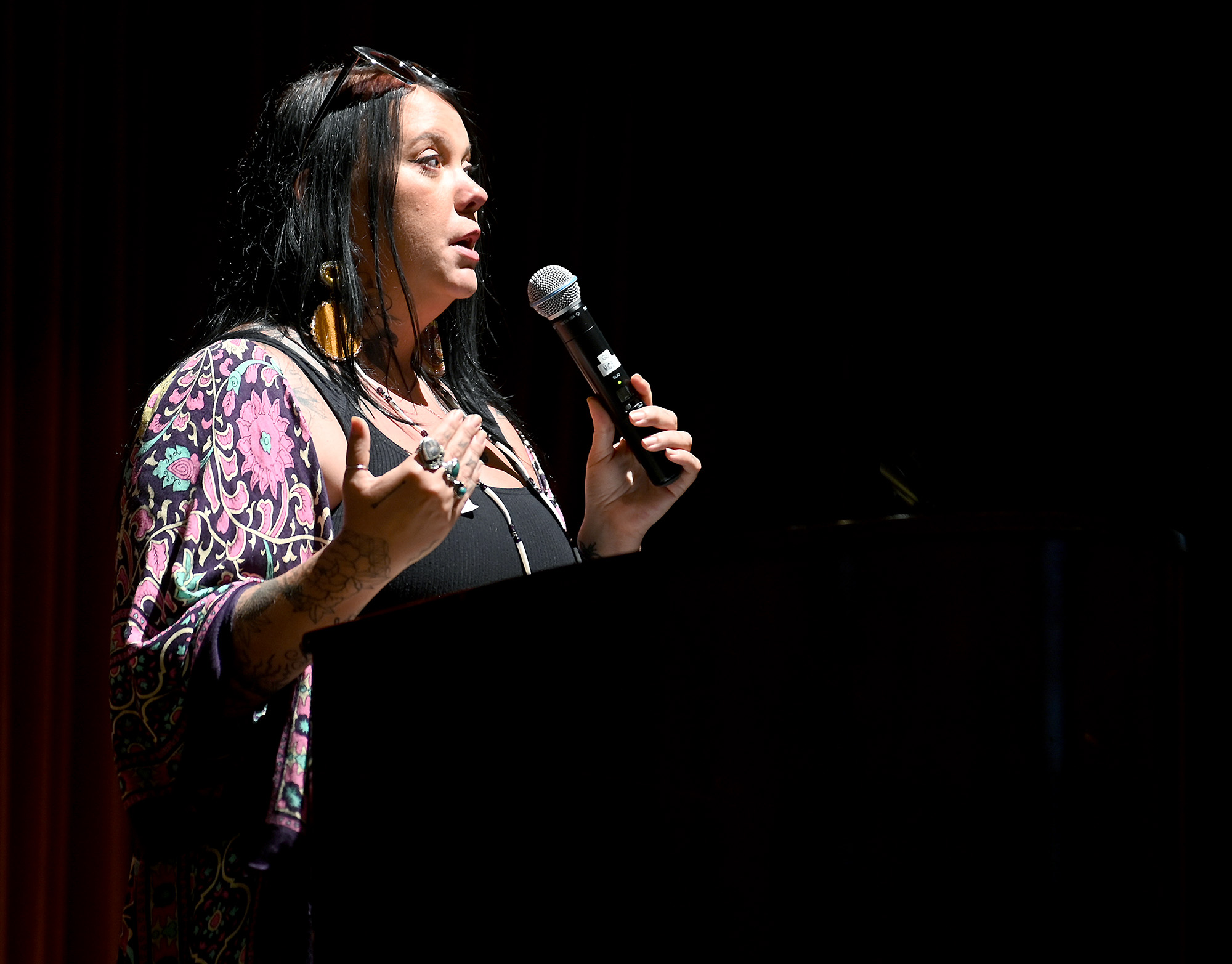
This year’s keynote speaker was author, illustrator and Tribal member Steph Littlebird. Littlebird published the picture book “My Powerful Hair” in 2023, which received the national Carter G. Woodson Social Studies Award the following year. She also published “You Are the Land” in February, which was named a top 10 picture book of 2026 by the website Goodreads.
Littlebird discussed the importance of her Indigenous background in her work.
“I am someone who shares the stories of our community, shares the values of our community,” she said. “And I feel like I am living my dream in getting to do that, getting to be part of the people who are rebirthing our culture as opposed to my ancestors who had to watch its destruction.”
Littlebird said that with the privilege of being able to share those stories comes a responsibility to make Indigenous experiences be heard.
“I recognize how privileged I am to be doing the work that I do and so with that privilege comes a great amount of responsibility to tell our stories and to make the invisible visible, because we have been invisible for so long,” she said.
Littlebird said she had multiple educators throughout her schooling who helped her develop a sense of self and purpose.
“You guys are my favorite people to talk to because … you’re literally saving lives,” she said. “I’m a testament to that.”
Following the opening activities, educators dispersed into breakout sessions held throughout the morning and afternoon.
Morning sessions included a Chinuk Wawa mini lesson and sign-making panel, a study of historical records that students could use to learn about their own family histories and connect them to classroom topics, an exploration of how 3D printing can be used for practical solutions, presentations about the Spirit Mountain Community Fund and Hatfield Fellowship.
There were also sessions on how Native-centered texts can encourage critical thinking and challenge stereotypes, a panel of Native students from Willamina High School, an examination of the Land Back movement and the history of the Tribe’s homelands, and a session focused on improving the educational needs and experiences of Indigenous students in Oregon schools.
Afternoon sessions included a Chinuk Wawa immersion lesson, a look at experiences while traveling across the Tribe’s homelands and how places can be used in educational settings and a presentation by Tribal youth who served as interns at the American Museum of Natural History in New York City this summer.
Other sessions included an exploration of how culture, community and relationships can provide learning opportunities for Native students, Indigenous trauma and restorative practices, a Chachalu Tribal Museum & Cultural Center panel, an interactive class on making beaded necklaces and a session on cultivating cultural safety and belonging for Native students.
Scheduled Grand Ronde presenters included Secondary Education Teacher Zoey Holsclaw, Shawash Studies Teacher Adam Langley, Information Systems Program Manager Alec Mercier, Spirit Mountain Community Fund Program Coordinator Angela Schlappie, Tribal member and middle school English teacher Cheyanne Heidt, Social Emotional Learning Specialist Amanda Mercier and Cultural Center Specialist Trudy Sylvia, Ceded Lands Manager Michael Karnosh, K-5 Academic Coach George Neujahr, Cultural Protection Specialist Chris Bailey, American Museum of Natural History Interns Ekias Sabin and Tidus Sabin, Teen Pregnancy Prevention Coordinator Matt Bucknell, the Education Committee and more.
Guest presenters included Oregon Department of Education Native American Student Success Coordinator Renée Roman Nose, Choctaw Nation of Oklahoma member Jen Anderson and American Museum of Natural History staff Maria Sawiris and Albeliza Perez.
Smoke Signals staff attended the following sessions:
3D printing
During Alec Mercier’s 3D printing session, he emphasized that technology could be used as a practical tool to solve everyday problems.
“We had a popcorn machine in our office and the door broke,” he said. “And so I took the part, measured it, modeled it and printed it several times and I fixed the door.”
Mercier displayed several examples of items he printed including a shelf he designed for webcams used by the Tribe, door stops, phone cradles, fidget toys, action figures, a flute, building models and replicas of dinosaur skulls.
During the session, Mercier also printed charging-port cleaners and gave them to attendees.
Attendees were very engaged and said 3D printing is always popular with their students.
Mercier explained that different materials can be used for 3D printing and displayed a model made from a corn-based material.
“This was made with a corn-based material and so it will degrade over time,” he said. “High heat or water will eventually melt it. And that’s kind of why I like printing with it because it’s cheaper and will actually break down over time.”
Philanthropy and Hatfield Fellowship
This session was presented by Spirit Mountain Community Fund Program Coordinator Angela Schlappie, who discussed the history of the Community Fund and what its mission involves. Schlappie went over the qualifications to apply for a grant, which is funded by 6% of the revenue of Spirit Mountain Casino.
The Community Fund offers both large and small grants for several different categories such as effective education for youth, environmental, health, food security/food sovereignty, housing/homeless, mental health, and pre/post-natal care.
A 501(c)(3) nonprofit organization, government agencies in Lane, Polk, Tillamook, and Yamhill counties, or one of the nine federally recognized Tribes of Oregon may all apply for the grants.
Tribal Council Member/ Spirit Mountain Community Fund Board of Trustees Vice-Chair Kathleen George discussed the Hatfield Fellowship.
“We’ve had 26 fellowships with the first one being (current) Tribal Council member Pete Wakeland,” she said.
George noted that the application for the 2027-28 Hatfield Fellowship opens March 1 and closes April 30.
For more information about the grant process or Hatfield Fellowship, visit thecommunityfund.com or email info@thecommunityfund.com.
American Indian/Alaska Native Student Success Plan
Oregon Department of Education Native American Student Success Coordinator Renee Roman Nose discussed the American Indian/Alaska Native Student Success Plan for the 2025-30 school years.
Nose went over the five main goals that are in the plan, which are: Championing Tribal languages by uplifting and amplifying Tribal language revitalization efforts, addressing inequity in Native student data by addressing disparate identification of Native students in special education, pursuing Native excellence through strengthening collaboration with Tribes and families to support early literacy, cultivating holistic systems of support by honoring educational sovereignty through Tribal consultation and lastly, centering culturally responsive approaches such as providing support to educators to successfully implement Tribal history/shared history lesson plans.
For more information about the AIANSSP plan, visit www.oregon.gov/ode or email renee.romannose@ode.oregon.gov
Cultivating Tribal social emotional learning opportunities
Tribal Social Emotional Learning Specialist Amanda Mercier discussed cultivating a Tribal aspect to social emotional learning.
“It’s not fair to them (children) to cut them off from evidence-based interventions that have high effectiveness that could support them,” she said. “They should have an opportunity for that, and we need to provide a space for that.”
Mercier shared that she recently went on canoe journey to provide social emotional learning opportunities and provide a safe quiet spot when the world was getting to be too much for the kids. She had noise canceling headphones and some sensory toys to play with. They had a tent area for the kids and there were adults who were also enthusiastic about that option, so Mercier is exploring it for next year.
Decolonizing behavior support
Amanda Mercier’s final session was on decolonizing behavior support for Native students. She went over some statistics and graphs showing how many students that are Native American/Alaska Native are getting put on a modified diploma track more often than their peers of other races, as well as how Native students are missing more school days compared to their peers.
Mercier also showed a video about boarding schools in North America and had a discussion with the audience about whether they think or believe that this is still affecting the Native culture.
An audience member spoke about how she had a grandfather and other relatives who attended the Chemawa Indian Boarding School in Salem, and how their experiences have affected the way some of her family looks at education.
Mercier ended the session with the audience breaking up into three groups and giving a situation in a classroom. The groups had to come up with a solution and present it to everyone.
In conclusion of the summit, De Turk gave a closing statement and did the final raffle drawings.
“As we come to the end of our 2026 Education Summit, I want you all to think about today and the theme, ‘Rooted in Community, Growing through Education,’ that education isn’t something that we do alone.”