
 Current Issue PDF
Tribal Government & News
Wakeland honored by Intertribal Timber Council with lifetime achievement award
By Danielle Harrison
Smoke Signals editor
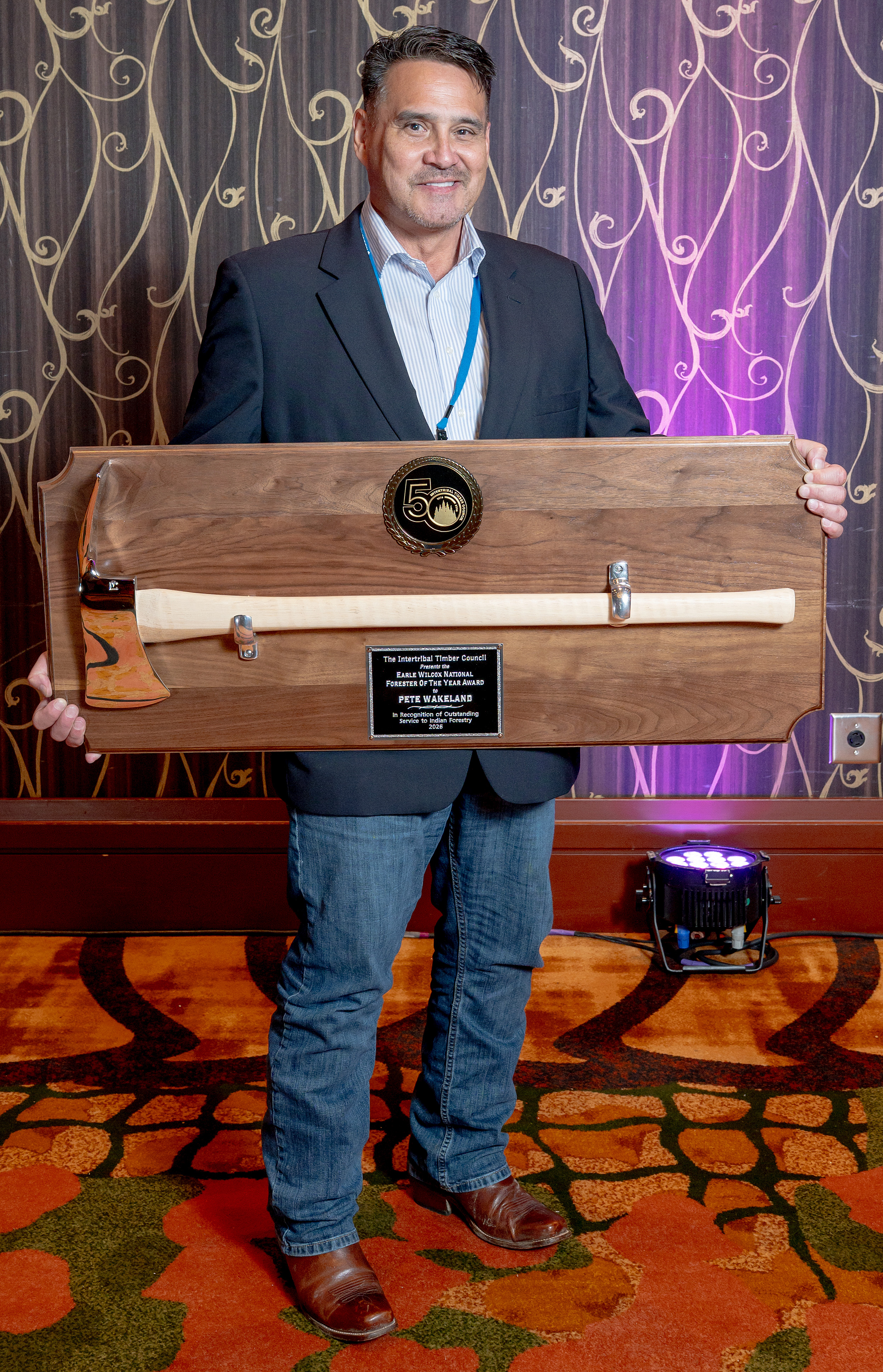
Tribal Council member Pete Wakeland was recently honored with the Outstanding Forester of the Year award from the Intertribal Timber Council.
Wakeland received the honor, which is part of the annual Earle R. Wilcox Memorial Awards, during the ITC’s annual National Indian Timber Symposium in Keshena, Wisconsin, held June 8-11.
“Earle R. Wilcox Memorial Awards honor individuals who have made significant contributions in the field of Indian forestry, fire or related natural resources programs.,” the ITC website stated. “These awards are given in honor of Mr. Earle R. Wilcox, who will always be remembered for his significant achievements on behalf of Indian people and their forests. Awards are given annually and presented at the symposium.”
Wakeland said he was very surprised to receive the award.
“I never expected this but I am honored to be among those who have received it before me,” he said. “This award is given only once in a lifetime to individuals who have made significant contributions to Indian forestry and fire over the duration of their career.”
Wakeland, a retired Bureau of Indian Affairs chief forester, graduated from Oregon State University’s College of Forestry in 1995 and began working for the Tribe’s Natural Resources Department.
In 1998, he was chosen as the first Spirit Mountain Community Fund Hatfield Fellow, working in Sen. Ron Wyden’s office in Washington, D.C.
According to his bio on the Tribe’s website, he worked for the Tribe as a forester, Natural Resources Department manager and deputy director of operations under the General Manager’s Office. He went on to become the first director of development and public safety for the Tribe.
During his time in the Natural Resources Department, Wakeland helped expand the wildland fire management and forestry programs.
“I don’t pat myself on the back, but during my career at Grand Ronde we transformed our forestry program and incorporated a more rounded program from timber production to a more balanced approach to timber management/forest resource production, while placing an increased emphasis on fisheries and upland game species habitat enhancement,” he said. “We proved that resource extraction and resource protection are not mutually exclusive. Grand Ronde’s Natural Resources Department is held in very high regard in Indian Country.”
He continued, “We also built an outstanding wildland fire program that has not only impacted the lives of many young Tribal and non-Tribal members but has become a model for Tribal wildland fire programs nationally. Our fire crews and wildland fire engines are dispatched to wildland fire incidents across the nation and recently assisted with fuels reductions projects in North Carlina on the Eastern Band of Cherokee Reservation. This didn’t happen overnight. It took many years of hard work and dedication.”
According to the ITC newsletter, Timber Notes, an awards committee meets earlier in the year to review and evaluate nominations. Scores were tallied by Awards Committee Chairperson Robin Harkins and each nomination was discussed by the group.
“The accomplishments of your peers in Indian forestry continue to be impressive,” the newsletter stated.
Wakeland added that another accomplishment he is proud of is implementing the Indian Trust Asset Reform Act, which was passed into law by Congress in 2016, while he was working for the BIA. The demonstration project authorized under the act was due to expire in June of this year.
“We worked with our elected officials in D.C. and the Bureau of Indian Affairs Assistant Secretary Billy Kirkland and his staff to get the demonstration project extended so that more Tribes have the opportunity to participate,” Wakeland said. “Basically, what ITARA does is allow Tribes to exercise greater sovereignty over the management of their forest resources. Participation requires Tribes to develop their own Indian Trust Asset Management Plan and Tribal forest regulations, which allows Tribes to conduct forest land management activities without further review of the secretary of the Department of the Interior. … It’s been a honor to have managed our Tribal forestlands here at home, as well as supporting the broader management of Indian forests from Washington, D.C. I’m also honored to be serving my Tribe, now as a Tribal Council member.”