
 Current Issue PDF
Tribal Government & News
Tribe manages forests for long-term health
By Nicole Montesano
Smoke Signals staff writer
Crawling through the woods on massive treads, the timber harvester, its operator hidden from view inside the cab, reaches out a single articulated arm, grabs a 40-foot Douglas fir tree and sends it toppling. It lifts it, cuts off the top, strips away the branches and sets it on the ground to be collected later. It crawls a few feet forward, selects another tree and topples it. Branches and fir needles are strewn across the tract between the remaining trees.
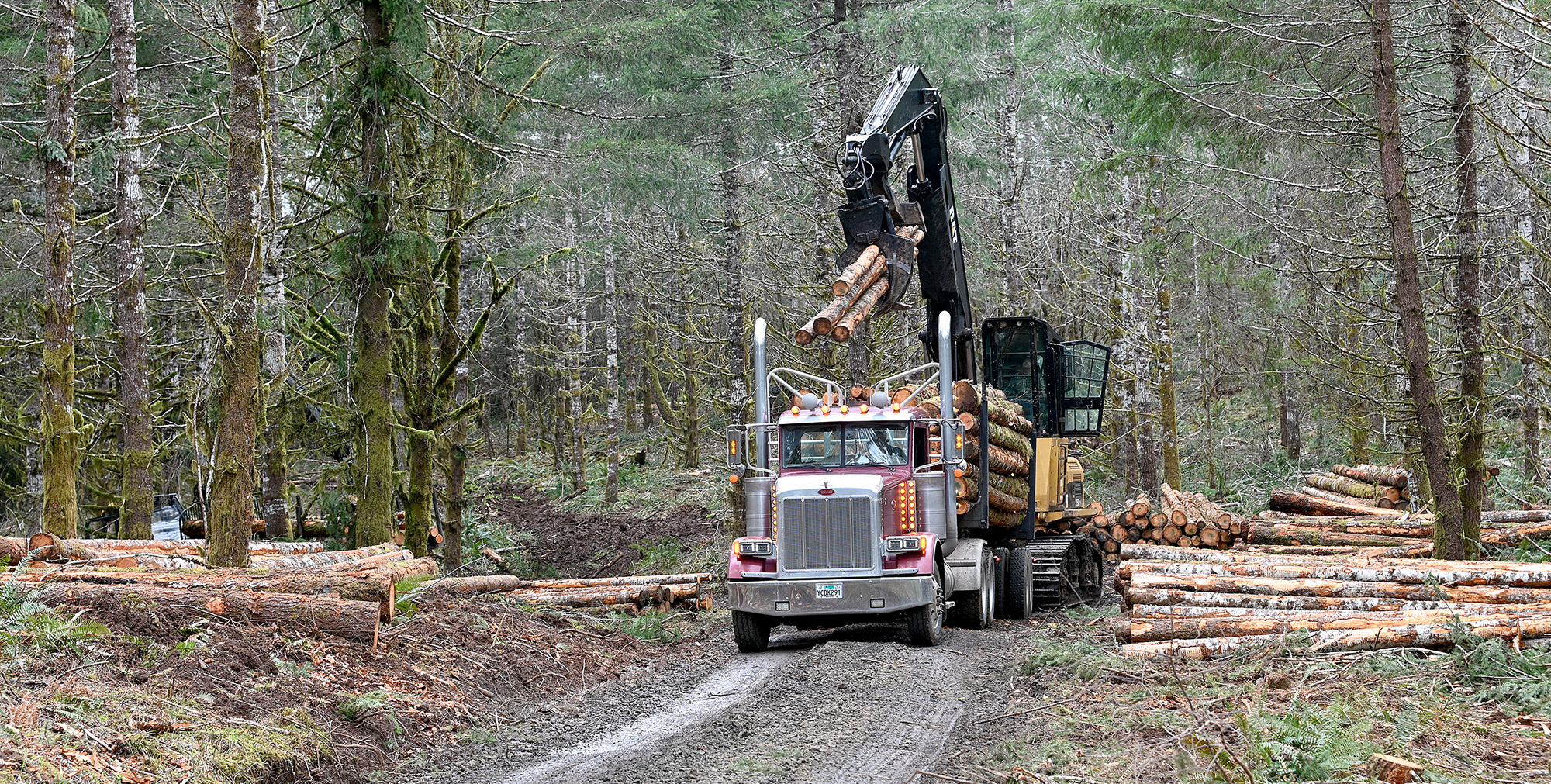
A second machine collects the logs and stacks them onto a waiting truck. The debris will be left to decompose, returning nutrients to the soil.
Tribal Timber Resource Program Manager Travis Trammell stands in the muddy ruts left by the treads, watching in satisfaction. The site may look a mess now, he said, but it will soon recover and the trees left standing will benefit from increased sunlight and decreased disease pressure from overcrowding. Understory plants like hazel, osoberry and snowberry will establish themselves, providing food and habitat for wildlife.
“In a year or two, you won’t even be able to tell they were here,” he said.
Trammell and the Tribe’s Natural Resources Department are focusing their management not just on obtaining revenue from logging, but on improving overall forest health. It requires a different approach, Trammel said, one that benefits trees, wildlife and Tribal cultural practices.
That focus, he noted, has not hurt the Tribe’s ability to sell timber; if anything, it increases quality.
“We have high demand,” he said, listing companies that buy as many logs as the Tribe will sell and ask for more.
Footage from Smoke Signals' tour of Tribal lands with Tribal Timber Resource Program Manager Travis Trammell.
But for the Tribe, forestry is about more than money. The health of the land itself and of wildlife is equally compelling. So, there are elk meadows left among forest stands, wide riparian buffers, three times more trees left standing in clearcuts than the state minimum. More spacing between trees allows for growth of underbrush and more diversity of tree species.
“That hillside over there, they clear cut and then crammed as many Doug firs in as they could,” Trammell said, gesturing to a hill covered by the iconic dark green conifer. “But if that hillside were to regenerate on its own, it would not look like that. That hillside is not meant to support a monoculture of Doug fir.”
Douglas fir grows well in the foothills and higher slopes of the Coast Range and reseeds readily, Trammell said. But it was never the sole tree species there. The Tribe’s new 10-year forest management plan for 2024 to 2033 calls for planting just 30% Douglas fir, 30% western red cedar, 30% western hemlock and 10% other species – typically grand fir or Sitka spruce, he said.
Trammell noted it takes two years for the requested seedlings to grow before they can be planted.
“Next year will be the first year we can plant 30% of each,” he said.
Tribal Silviculture Coordinator Waylon Rich, who works in the Tribe’s silviculture program, said that previously, the Tribe planted some 90% Douglas fir, “with a sprinkling of hemlock and red cedar.”
Science backs the benefits of greater diversity, Rich said.
The hemlock and cedar will be left standing when the firs are cut and serve multiple purposes. Trammell pointed out where dying Douglas fir trees show the presence of root rot fungus. It’s found throughout the area, but is worse in certain areas and crowding helps it to spread. The Tribe is conducting an experiment; removing the dead trees and replacing them with western red cedar and western hemlock, which are more resistant to the fungus.
The Tribe maintains 11,735 acres of trust forest land, including 1,523 acres of forest set aside for conservation, where the only logging is thinning for long-term forest health.
The 10-year plan sets an annual target of harvesting 5.02 million board feet of lumber, which counts clear cuts – referred to in the plan as “regeneration harvests” – thinning, salvage and special projects – with adjustments made as needed over time. It calls for a 70-year rotation age for clear cuts in most areas and a maximum clear-cut size of 60 acres, with 40 acres preferred.
Thinning is typically conducted on trees around 35 to 40 years old, Trammell said, although that can vary. The thinning operation was happening on a tract that had been closely planted with all Douglas fir.
“You can see there’s almost no understory,” he said. “Removing smaller trees allows those remaining to grow to high quality, healthier trees.”
Trammell said the goal is to leave about 18 to 20 feet between trees, allowing more light to reach the forest floor, spurring the growth of both the trees and other vegetation.
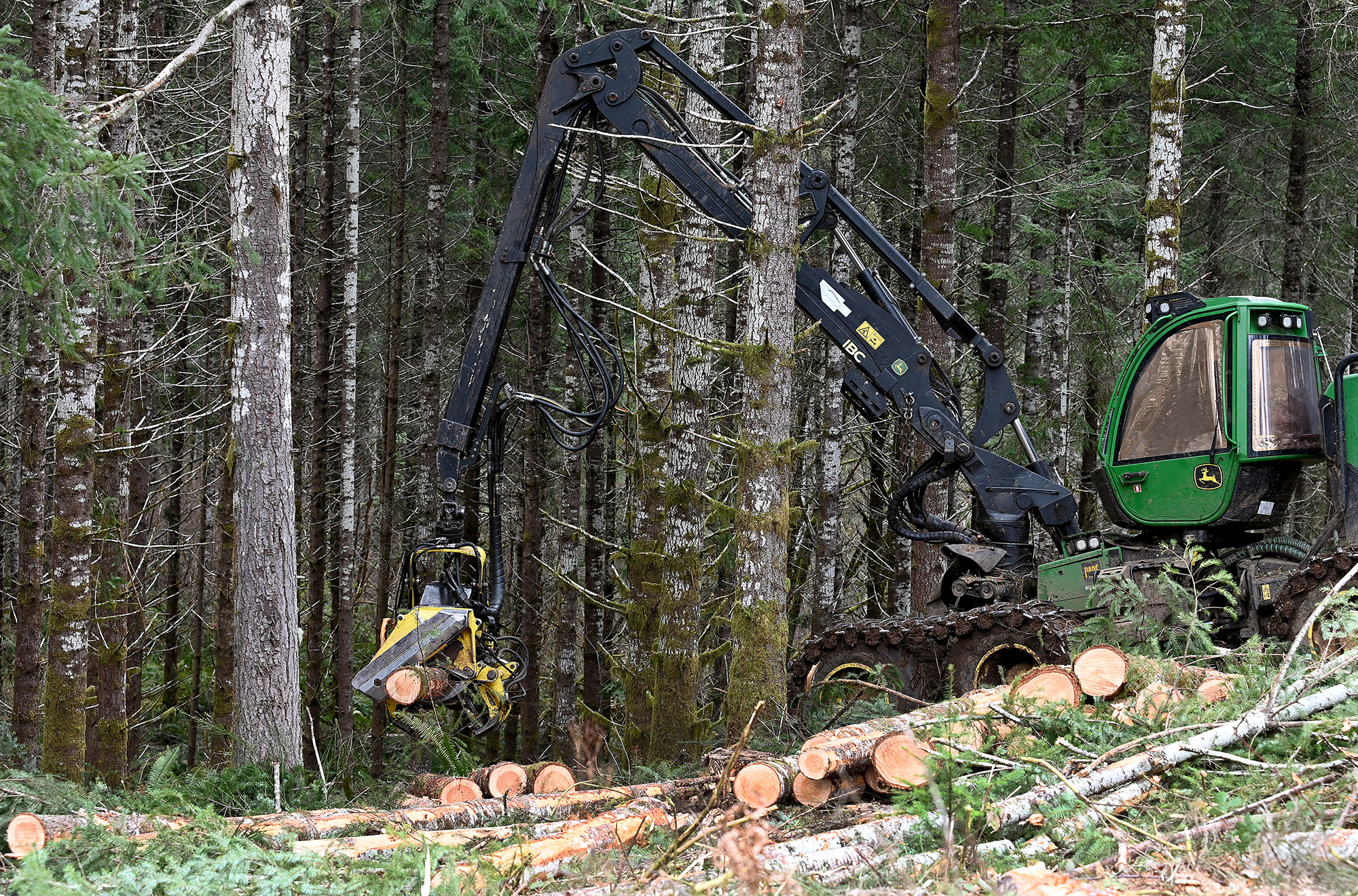
A harvester grabs and cuts a Douglas fir tree as a thinning operation takes place on Tribal timber land Tuesday, March 17. (Photo by Michelle Alaimo)
He noted that, “This is purely for forest health – healthy trees, good habitat for wildlife. It will be 30 years from now before somebody has to decide” whether the stand should be harvested.
Trammell compared the Tribe’s tracts to neighboring tracts owned by large timber companies or the federal Bureau of Land Management. Heavily sprayed with herbicides, they have little to no underbrush.
“All you see is trees and dead stuff,” he said. “We could get as good or better results if we could burn (the sites). “It’s just politically difficult for us. … It’s starting to come back (into use). Hampton is starting to do some burns along with us.”
Hampton Lumber owns some 100,000 acres of timberland in Oregon.
Although the Natural Resources Department does conduct some herbicide spraying, it also relies heavily on manual labor.
“…So a private landowner is gonna use the herbicide across the whole area – the Tribe doesn't do that,” Rich said. “When we do have an herbicide application, say along the road, it’s for invasive species – Himalayan blackberries, Scotch broom and reed canary grass – and it's specifically to keep those from spreading. We don't do that for competing tree species – we use chainsaws for that. It’s definitely not cost effective; it's time consuming and labor intensive, but the benefit is we're not spraying a bunch of herbicides.”