
 Current Issue PDF
Tribal Government & News
Wakeland blazing a path with degree in national fire program
By Nicole Montesano
Smoke Signals staff writer
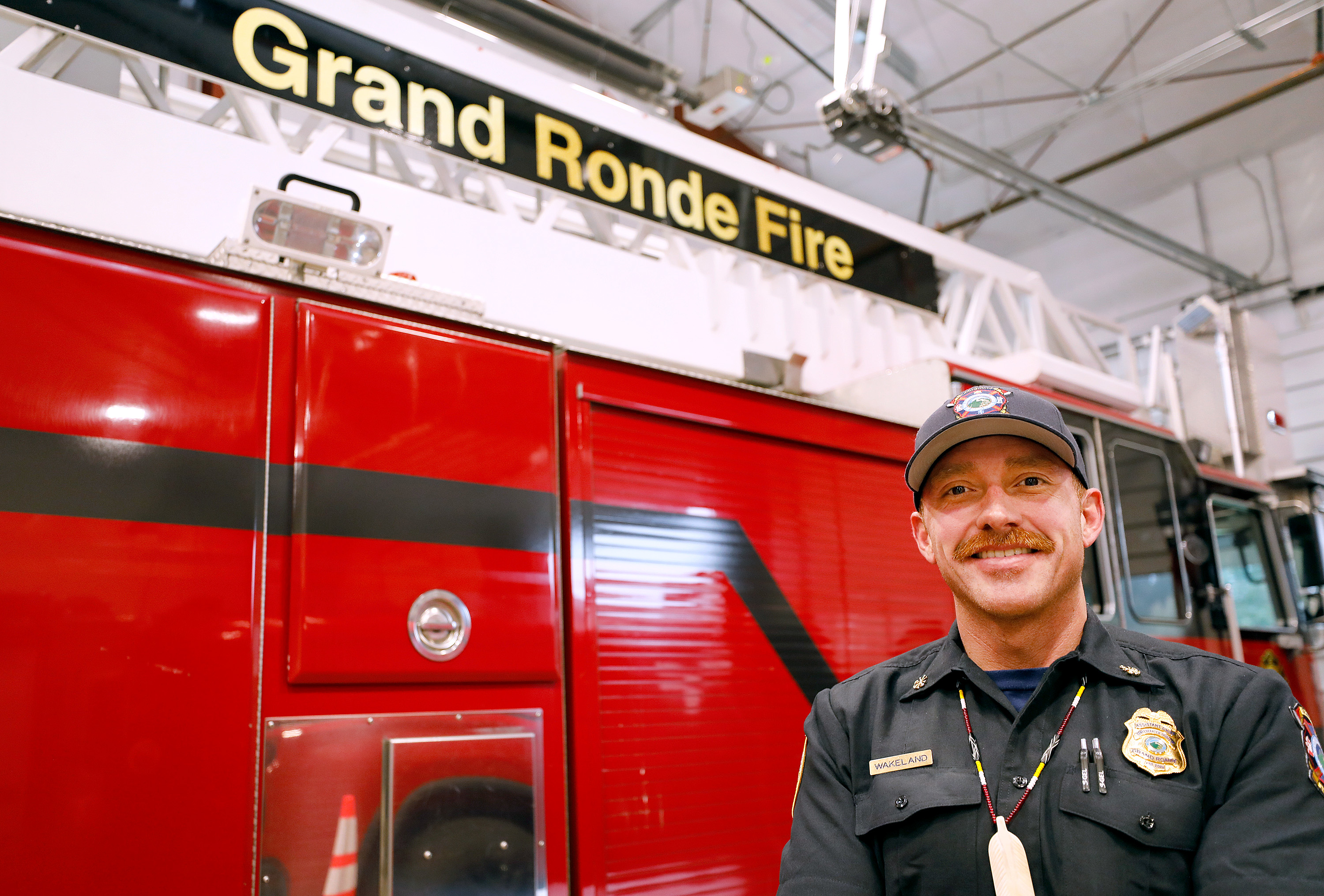
Tribal member and Tribal Assistant Fire Chief Torey Wakeland is blazing a path forward as he pursues a graduate level degree in the Executive Fire Officer Program from the National Fire Academy.
Wakeland, 40, will be the first Tribally-enrolled fire chief or assistant chief to graduate from the program. Due to delays from federal shutdowns, he expects to graduate sometime next fall.
He has more than a degree in mind: Wakeland also aims to institute a program to address the long-term health of the Tribe’s firefighters. The course requires a capstone program, similar to a master’s thesis, but intended to result in a tangible outcome for the graduates’ home departments.
“I wanted something meaningful,” Wakeland said. “We see a lot of stuff; we go through a lot of stuff. I want to see our firefighters and emergency responders, when they get to retirement, be mentally healthy with peace in their hearts. … I don’t want them dealing with issues that have been buried for years.”
Although exposure to smoke and hazardous chemicals play their own role in long-term health effects, it’s the emotional toll of trauma on the body that has seized Wakeland’s interest, along with a potential remedy: A dog trained to help firefighters reduce their stress. So, he’s researching how to create a program for a trained department therapy support dog. He said he’s currently immersed in research about the effect of firefighters’ careers on their health.
Firefighters and emergency medical technicians respond to some of life’s most painful moments – drug overdoses, car crashes, medical emergencies, fires – attempting to help badly injured, sometimes dying patients and calm distraught family members.
Witnessing those tragedies hurts and often stays with the responders long after the call is over, sometimes in the form of post-traumatic stress disorder. The stress and emotional effects, combined with hours away from family, disrupted sleep, long working hours and reluctance to talk about what they’ve witnessed, can take a toll on relationships, creating additional stress and anxiety, as well as a loss of emotional support.
Long-term effects include heart disease, strokes, neurodegenerative conditions, cancer, chronic anxiety, post-traumatic stress disorder, mental health struggles, divorce and high risk of suicide – mostly stemming from the years or decades of enduring repeated emotional trauma in the course of the job.
In the past, Wakeland said, first responders were expected to simply cope with that pain and stress on their own.
“There was a stigma to seeking out mental health counseling,” he said. “It seemed like a lot of folks were just beaten down because they were never offered these services.”
Wakeland recalled a firefighter from the West Valley Fire Department, which preceded Grand Ronde’s station, who took his own life in the department’s parking lot. He said he doesn’t want Grand Ronde’s firefighters to live with that kind of pain.
Early on, he created a peer support program for the department’s firefighters, overseen by a licensed counselor who offers private and group counseling, and who brings her own therapy service dog two or three times a week. The State Fire Marshal’s Office now has two dedicated therapy dogs that sometimes travel to departments or fire camps to comfort and support firefighters.
Wakeland said he sees a Grand Ronde Fire Department service dog as the natural next step.
“More and more stations are trending toward having a service animal living at the station,” Wakeland said.
It’s a trend Grand Ronde station members are eager to embrace. “At least once a week I get asked, ‘When are we going to get a service dog?’” he said.
According to the National Fallen Firefighters Foundation, “Interacting with therapy dogs provides a welcome distraction from firefighters’ stressors and challenges. Engaging in activities with the dog can divert attention away from anxiety-inducing thoughts and promote relaxation. A therapy dog can become a trusted companion, allowing firefighters to express their emotions and process their experience healthily. These dogs serve as a source of comfort and stress relief, helping firefighters find solace and recharge.”
By the time he graduates, Wakeland said, he hopes to have a proposal, complete with funding estimates, descriptions of how the program would work, details about acquiring, training and caring for the dog and supporting research, ready to present to Tribal Council.
“I’m studying housing, caring for one, the benefits of having one,” he said. “It would be another level of health services we provide to our firefighters.”
Wakeland has had a varied career at the Tribe, starting in 2004 when he joined the first all Grand Ronde wildland fire crew. He’s continued to work seasonally for the fire crew, he said, while moving through a series of other jobs for the Tribe: Aquatic biologist, a stint as Ceded Lands Department manager, an environmental policy analyst and then division chief of training and recruitment for the newly-created Grand Ronde Emergency Services Department six years ago, when the Tribe took over providing emergency fire and medical services for much of the West Valley.
Today, he serves as assistant chief.
“We’re still getting things buttoned up and concentrating on finer details,” Wakeland said, noting there are a lot of components the department has to be prepared to respond to, including structure fires, vehicle crashes, hazard response and medical emergencies of all kinds.
While attending courses at the National Fire Academy in Maryland, Wakeland said, he learned about its graduate program and decided to enroll.
“There was a very extensive application process,” he explained, with 500 candidates nationwide chosen for a second round of selection.
Wakeland was one of the final 150 accepted into the two-year program. It requires in-person classes in 10-to-12-day stints, followed by six months at a time of remote online work.
“It’s very academic-heavy,” he said. “There are lots of hours put into this.”