
 Current Issue PDF
Health & Education
Tribe to hold screening of dementia documentary
By Nicole Montesano
Smoke Signals staff writer
In 2016, Kitty Norton moved to Portland from Los Angeles, leaving behind her job as an NBC assistant editor to join her sister in caring for their mother, Gloria, who had been diagnosed with dementia.”
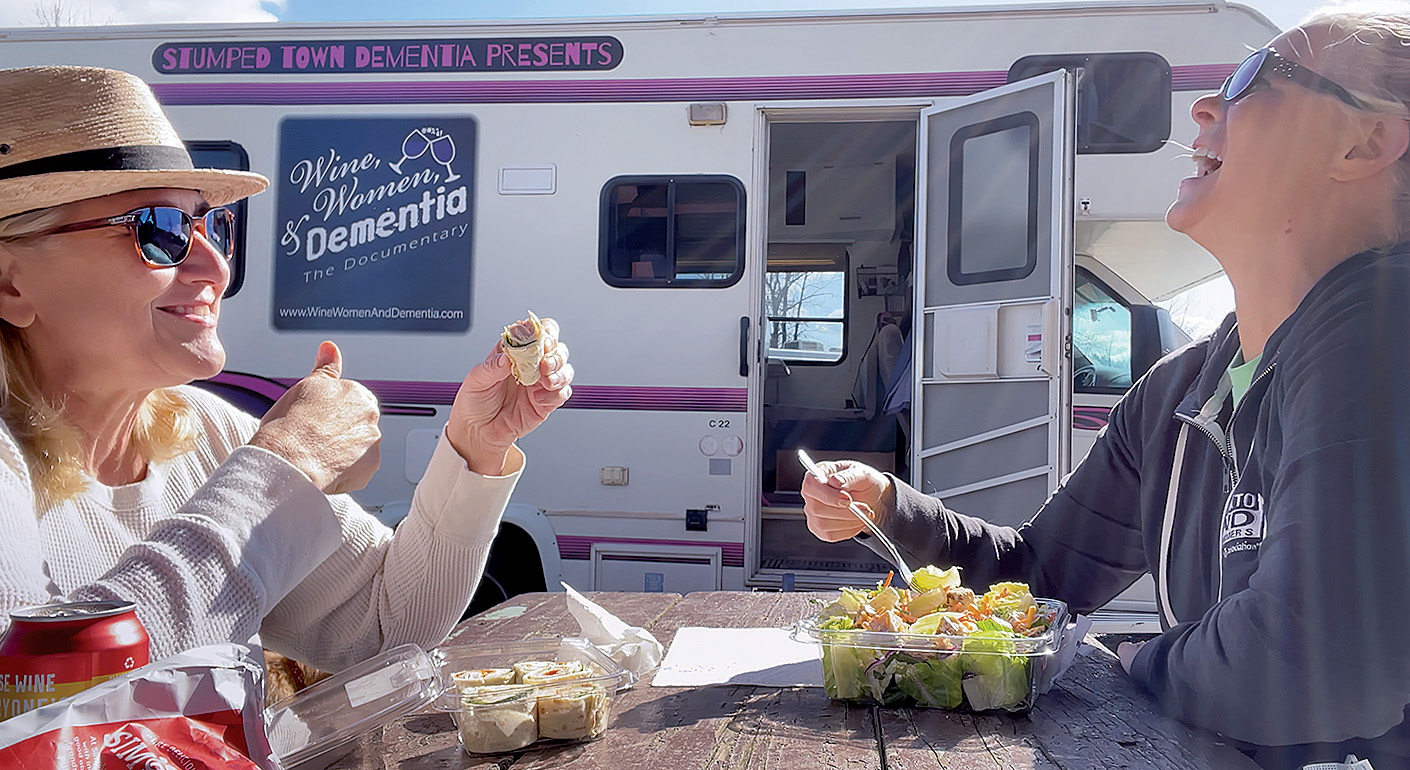
Realizing she needed more support, she created a blog, “Stumped Town Dementia, to connect with other caregivers and through it, made friends around the country. After Gloria’s death in 2021, Norton decided to drive an RV across the United States to meet many of those online friends in person and to create a documentary about the experience. A friend, producer Beth Rigazio, journeyed from her home in California to join Norton on her trip, accompanied by a film crew.
The result is “Wine, Women & Dementia,” an hour and a half-long film about the realities – difficult, funny and heartbreaking – of caring for a loved one with dementia. It is intended, Norton said, to reassure caregivers that, “You’re not the only one who has these feelings you don’t feel like you can say out loud,” and to encourage them to connect with other caregivers for mutual support.
The Tribe’s Brain Health program in the Community Health Department is presenting a free screening of the film for the Grand Ronde community at 5 p.m. Tuesday, March 3 in the Tribal gym. It will be followed by a discussion led by Norton. The event is open to the community. A meal will be provided and raffle prizes will be given away. Contact Community Health at 503-879-2078 for more information.
Tribal Dementia Care Specialist Barbara Worthington, who organized the screening, said she has first-hand experience with the subject.
“I, too, have been a caregiver to three family members with differing types of dementia,” Worthington said. In September 2025, “I was invited to attend a W.W.D. screening … by a former Northwest Senior and Disabilities colleague of mine, Suzy Deeds. While I was unable to attend that day, I was captivated by the trailer and synopsis, which I felt reflected the love, humor, dedication and heartbreak that come with providing care to a family member living with dementia,” she said. “I then stumbled upon Kitty’s website/blog, ‘Stumped Town Dementia,’ which is every bit as raw, insightful, humorous and helpful as the screening.”
Norton’s blog, Worthington said, “felt like a family caregiver speaking directly to family caregivers, so I decided to fill out a “contact us” request on her site — adding a humorous subject line to get her attention (‘You had me at poop’).
“It worked,” Worthington said. “We quickly connected, as family caregivers tend to do and met up for lunch … and the rest is history. Sometimes the bravest step in caregiving is taking a small risk to reach out, connect and realize you don’t have to do this alone. I applied that to connecting with Kitty and am grateful that she reciprocated the feeling.”
It’s not only the grief of navigating the loss of a loved one’s memories and mental competence that makes caring for someone with dementia so incredibly difficult; if anything, Norton said, that’s the least of it. It’s the strangeness of the behaviors that can emerge. It’s the combination of grief with hilarity, resentment, anger, anguish, shame for falling short along the way and the lack of clear medical answers, leading to endless uncertainty about what to do. One of the caregivers featured in the film notes her frustration with continually being offered lists of things she and her husband “could try” for her father, rather than clear recommendations from medical professionals.
Norton came away from her experiences with two messages for caregivers: Reject what she calls “the tragedy narrative” and find other caregivers to lean on along the way.
“Get out there and get ‘em. I don’t know how you think you can get through this without ‘em,” she said.
According to surveys provided to audiences, Norton said, the film is leaving people feeling validated and better able to support loved ones with dementia, which is what she wanted to accomplish.
“We’re not doing anything magical in the film except bringing a different perspective,” she said. “Bringing some humor to your journey might help you and having someone to talk to, sit and have a cup of tea with, and sit and bitch and vent … and when you go back to your person, you’re a little more supported, you have more perspective. Now you can find a little humor, instead of just falling off a cliff of anger.”
The film aims to “talk about what it’s really like – when you can’t get away from your person and they’re already mad at you and dealing with what all that looks like,” she said.
People ask regularly, Norton said, what can be done to support the caregivers in their lives and there’s one overwhelmingly consistent answer.
“We want time away,” she said. “I’m not talking a one-week vacation. I’m talking about somebody shows up three times a week and gives me a few hours.”
That might be accomplished by friends or family volunteering to sit with the person or helping out with money, so caregivers can pay for a helper, she said, or by using respite care centers that are available in some places.
The tragedy narrative, Norton said, will make a difficult journey harder than it needs to be.
“There’s a lot of tragedy in this journey, but there’s a lot of tragedy in every end-of-life journey,” she said.
People often think that, “As soon as you get this diagnosis, the person in your family just turns into a babbling idiot and it’s like no – they probably have mild cognitive impairment at that point. They still have opinions; there are a lot of things they still can do.”
Norton said she’s in touch with people with dementia both in the United States and elsewhere, who are taking charge of their own futures and despite their cognitive impairment, are researching where to live, offering testimony, even writing legislation, to improve life for people with dementia and for their caregivers.
“I’m finding that very inspiring,” she said. “There’s this guy I met when I was taking care of mom, I think he was diagnosed in like 2011 and he is still attending like the world dementia conferences, he’s still giving his input of ‘nothing about us without us. You need to talk to us.’”
Even at stages of greater impairment, Norton said, people with dementia are not inert or voiceless.
“If you want to pretend your person is never going to have feelings again, never going to have likes and dislikes and opinions about issues, you’re selling everybody short,” she said. “I think a lot of caregivers find that. You don’t necessarily want mom’s opinion on what to have for supper, but she certainly has one.”
Norton said that her mother rejected many of the foods she had previously loved, but found new enjoyment in different foods that had not been favorites before.
There were other surprises, as well, she said, recalling a day when she cut herself on a piece of broken glassware, so severely that she had to call the paramedics for assistance.
“I’m trying to call paramedics and keep mom calm and keep a towel on my thumb … and then after the paramedics got there, there was Mom, calmly cleaning up the blood,” she said.
She said she learned she needed to “kind of lock the house down, because she was a wanderer,” but that “I finally got calm enough to let her have her own thing, once I made sure she wasn’t going to wander off in a snowstorm. … I kind of bought myself time by relaxing and letting her do her own thing.”
There will be days, Norton acknowledged, when “There’s no humor to be found,” and on those days, the support of another caregiver who understands can be vital.
Acceptance was also key.
“Letting her be herself, even though that self was wildly different than the self I had known most of my life, was certainly worth knowing and worth doing,” she said.