
 Current Issue PDF
Health & Education
Tribal member tapped to lead recovery center
By Nicole Montesano
Smoke Signals staff writer
Throughout her childhood, Grand Ronde Tribal member Alicialeigh Selwyn had a dream. She wanted to be a psychiatrist and to help people. She lost that dream for a while, falling into despair, alcohol misuse and drug abuse as a young adult. Once she had sought treatment, she grieved, she said, “for lost time.”
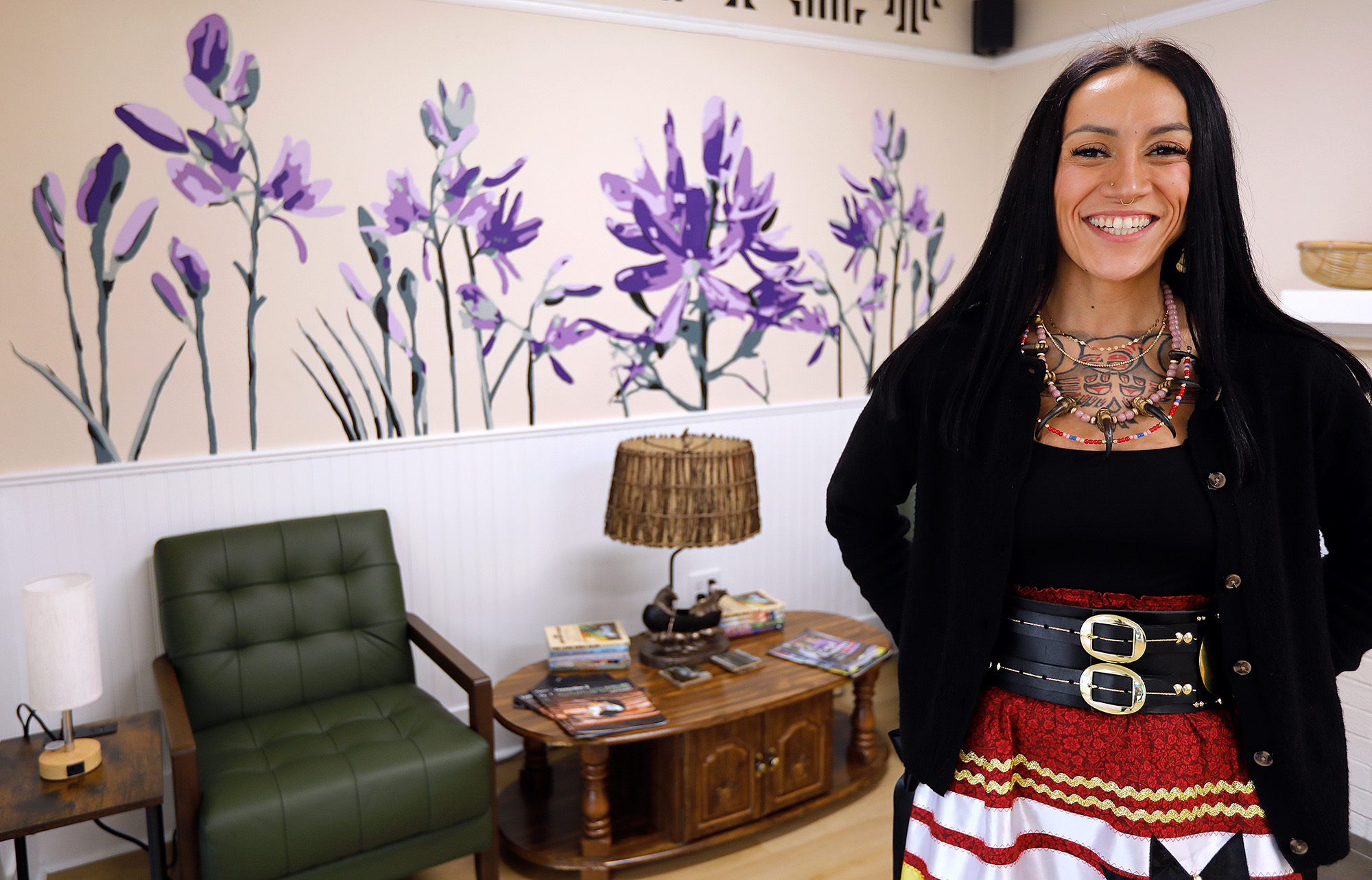
But those hard, painful years are standing her in good stead. Selwyn is back on her life’s path, armed with personal insight into the struggles of those she wants to help along with formal education in psychology and mental health studies. In late November, Painted Horse Recovery, a center dedicated to supporting Native Americans recovering from addiction with peer support and cultural connections, opened a new peer mentoring center in Salem. Selwyn was tapped to lead it, based on those same struggles and her hard work to overcome them.
Located in a historic house in Salem, the Painted Horse Recovery BuffaloBoy Center offers both community members and Native Americans a place to gather and spend time. But for Native Americans who are struggling to find a way out of drug addiction and alcoholism, it offers peer support mentoring and assistance ranging from help with paperwork to accompanying people to court hearings for moral support.
Selwyn said she follows the “two-eyed seeing” approach “taught by Mikmaw Elder Dr. Albert Marshall, learning to see through one eye with Indigenous knowledge and the other with Western knowledge.”
Culturally based support, she said, is crucial for Native people. “The research shows that our people heal best through their culture and community,” she said.
Selwyn grew up in the Grand Ronde area. Her childhood was marked by generational poverty and intergenerational trauma.
“Despite the circumstances, I had a good understanding of why things were the way they were and I wanted to help people,” Selwyn said. “But I didn’t have the tools to make that happen when I was younger and I didn’t have a lot of support.”
As a young adult, there were a lot of ups and downs.
“When I was doing good, I was doing really good, and when I was doing bad, I was doing really bad,” she said. “I got in trouble with the law, with alcohol and drugs.”
The cycle lasted for several years, she said, but eventually, “I got tired of the series of ups and downs, and being stuck in a dead-end job. … When COVID hit, I decided to get help. I wanted the second half of my life to be as good as the first half had been bad.”
It wasn’t easy, she said, especially “because I realized that a lot of my identity was a trauma response. I’d been living my life on high alert.”
Still, Selwyn persevered. Getting help, she said, “led me to get a lot more involved and showing up in the community at events and getting involved in the community again. Before that, I was kind of off in my own world.”
As time went on, she remembered that childhood dream.
“I decided I wanted to go back to school and help people,” Selwyn said. “More specifically, help heal our people and our families.”
Three years ago, Selwyn’s niece was born and she found herself more determined than ever to pursue her healing path.
“I decided to get into dancing, because I always wished I had an auntie to teach me cultural traditions,” she said. “She was a big part of my commitment. I spent a lot of time taking care of her while her parents were at work. I wanted to be a good example for her. I never wanted to be incapacitated in a way that I couldn’t be there for her.”
A nephew has since joined the family, and Selwyn said being an aunt to the children “is the best part of my life.”
As she graduates from George Fox University and turns 38 in the same month, while also starting her career as the director of the BuffaloBoy Center, Selwyn said, she feels as though she’s following “a sacred calling.” The center is named for Debra BuffaloBoy, a member of the Standing Rock Lakota Sioux Nation. She is a prominent member of the Indigenous addiction recovery field who serves on the board of Painted Horse Recovery.
The BuffaloBoy center is crucial for other Native Americans who want to extricate themselves from a life of drinking and drugs, Selwyn said, because there are few culturally based services available. All employees must be Native American and have lived experience with addiction, Selwyn said.
“They actually reached out to me,” she said, to offer the director position. “I do know the founder from back in the day – party days, those younger, not-so-healthy versions of ourselves. And he knows the journey I’ve been on.”
Selwyn said she had planned to go to graduate school next but decided the job wasn’t one she could pass up.
“It felt like a sacred calling,” she said. “It’s a large responsibility to be in this position in this organization and I was always taught that when a sacred calling comes along, you answer it, so long as you understand the responsibility and have what it takes to answer it. And I believe that even without experience, I can be successful at this. It aligns perfectly with my vision and values and wanting to serve my people.”
The center so far has two peer mentors to serve clients. Eventually, Selwyn said, the plan is to expand the center to add counseling services. She said she still plans to go to grad school part-time so that she can eventually become a counselor.
In addition to mentoring services, the center will offer community events and cultural activities such as classes in drum making, regalia making and dancing. It will also offer 12-step meetings.
The BuffaloBoy Center is located at 1800 State St. in Salem. To reach the center, call 503-810-5281, visit www.paintedhorserecovery.org or walk in.