
 Current Issue PDF
Culture
Indigenous garden workshops include Tribal member presentations
By Nicole Montesano
Smoke Signals staff writer
First foods are still revered by the Grand Ronde Tribe today and harvested by many Tribal members across Oregon, Tribal Cultural Policy Analyst Greg Archuleta told his audience in a January lecture.
Archuleta, a Tribal Elder, is participating in the Wildlife and Water Friendly Gardens series currently being offered by the Clackamas Community College Environmental Learning Center in Oregon City. It features presentations from Tribal members and organizations about traditional Indigenous perspectives and practices focused on protecting wildlife and watershed health.
The free weekly workshops are presented on Zoom at noon every Thursday through February. Signup is available online, at eventbrite.com/e/wildlife-water-friendly-gardens-free-series-2026-tickets-1964503064549.
During the second workshop Jan. 15, Archuleta spoke about Tribal oral histories and how first foods still play an important role for many Tribal members.
Future presentations will include a talk on “Reconstructing Willamette Valley Environments,” by Tribal Elder and anthropologist David G. Lewis Feb. 12, and one on “Indigenous Partnerships and Restoration,” by Archuleta on Feb. 19.
Some of the most important foods relied on by Indigenous people in the Willamette Valley were camas, cow parsnip, berries, nettles, tarweed, yampah, white oak acorns, hazelnuts and wapato, Archuleta said.
Today, Tribal members sometimes plant them in home gardens. Before contact with European settlers, Tribes encouraged the growth of useful plants in a variety of ways and also traveled regularly to different sites where particular foods were in season.
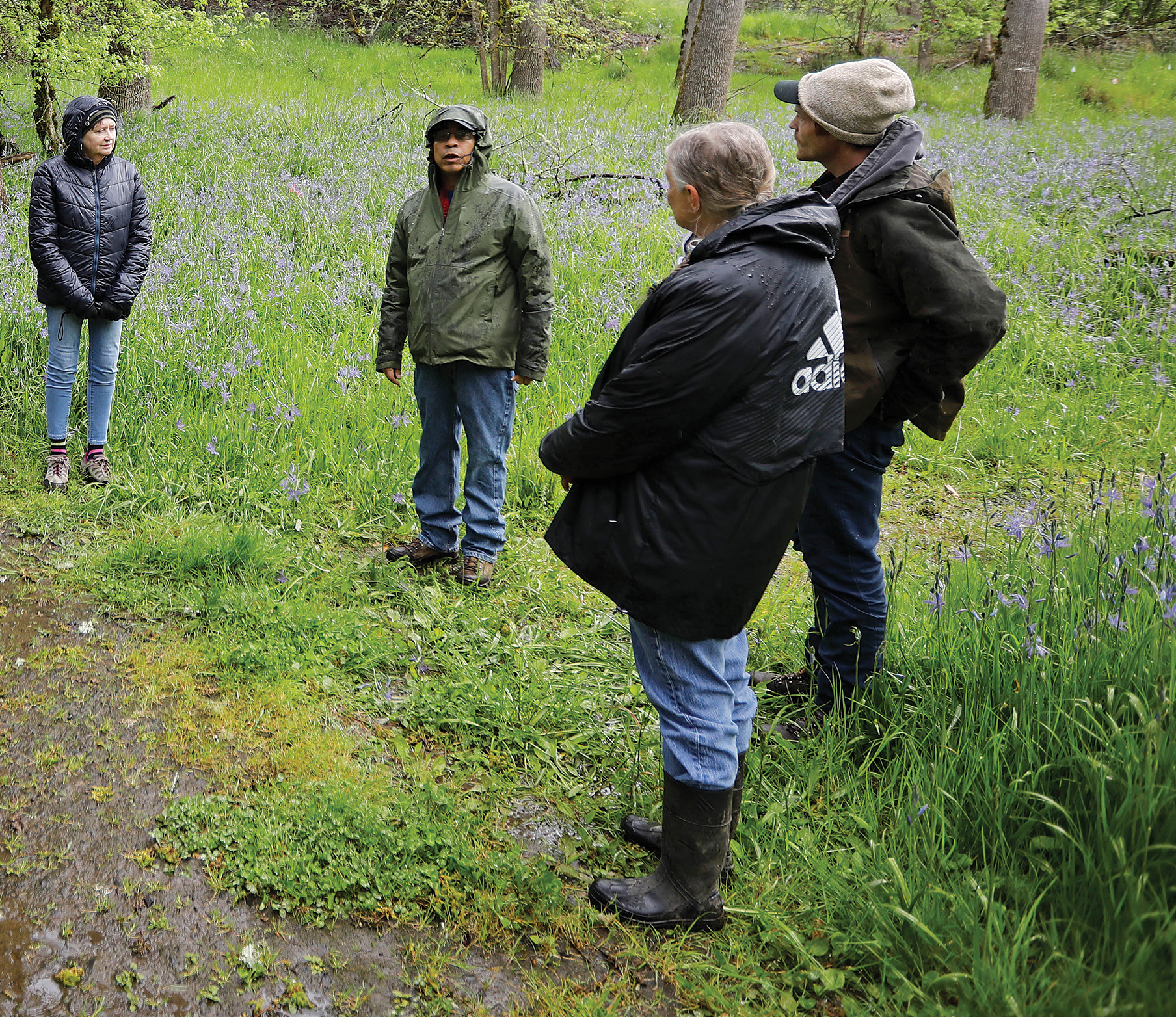
Camas, which grows in wet soil conditions, was found throughout the Willamette Valley, Archuleta said, and was “a very important first food.” The Tribe still has gathering areas throughout western Oregon.
Common camas, which has edible bulbs, also grows alongside a more dangerous companion, known as death camas.
“The bulbs are pretty similar so you have to be pretty careful,” Archuleta said. “There are some stories about settlers thinking they were getting wild onions and it turned out to be death camas.”
The Tribes, however, considered death camas a useful plant.
“We consider it a medicine and people knew how to fix it in a way that would just make you throw up when you needed to have that happen,” he said.
Using digging sticks often made from serviceberry wood, Tribes would gather camas bulbs in large quantities in the fall after flowering was finished and bake them for two or three days in underground earth ovens, sometimes pouring in water to create steam. The lengthy baking transforms the inulin in the bulbs to a more digestible form, Archuleta said.
“Lewis and Clark traded for camas on their journey and a lot of times they had stomach problems due to not preparing it properly,” Archuleta said.
Clackamas people, he said, would bake the tubers and store them for winter, while the Kalapuya people mashed the cooked bulbs into large cakes and dehydrated them. The dried cakes were a popular trade item at Tumwata, Archuleta said.
The stalks of cow parsnip and nettle could be peeled, steamed and eaten as a vegetable when young, he said. Strawberries, salmonberries and thimbleberries were generally enjoyed raw, while serviceberries were dried and stored for winter. People also harvested huckleberries and blue elderberries, he said.
Tarweed, a kind of wild sunflower, was valued for its seeds. In August, Archuleta said, Tribes would set fires to “burn up the tarry substance” the plants are named for, then use seed fans to knock the seeds into gathering baskets.
“Then they would grind them into flour and often use it as a kind of addition to hazelnuts or acorns,” he said. “It was pretty extensive in the Willamette Valley and southern Oregon. After contact, a lot of these were removed due to pasturing; they didn’t like to get the tarry substance on the animals. You pretty much get that scent all over you.”
Yampah, which looks similar to Queen Anne’s lace (a flowering plant) and has largely been supplanted by it, was another popular vegetable, often eaten boiled.
“They have a really nice taste, kind of like a yam” Archuleta said, noting that the seeds and leaves are also edible. “But watch for similar-looking hemlock (which is poisonous). You really have to know your plants.”
The name Champoeg, Archuleta said, is a corruption of the name for “place of yampah,” tchampuick.
There’s been significant yampah restoration at the Champoeg State Park site, Archuleta said, and when the Tribe was consulted about restoring the landscape, they made sure yampah was included.
Tribes made extensive use of Oregon white oak acorns, developing different methods to remove the tannins, Archuleta said. Some cracked the acorns and stored them in baskets in streams for a period of time, while others ground them into flour first, then ran either hot or cold water through the meal.
“It’s nice to see the old oaks surviving today that probably provided acorns to our ancestors,” he said.
Hazelnuts were another important food source and the Tribes set fires to encourage new growth.
“Today, there’s a lot of hazel on the landscape that’s not being maintained and so it’s not very productive and usually the critters get to them before you do,” he said. “Hazel is also important in basketry; it has a nice flexibility.”
The prevalence of commercial hazelnut orchards has had a detrimental effect, hybridizing with the native trees, Archuleta noted.
“The commercial ones are more brittle, so when we’re gathering, we have to do a lot of testing to make sure we’re getting the wild ones,” he said. “Because of the flexibility, hazel was also used in making rope.”
Wapato, a water plant also known as arrowleaf, was traditionally gathered by women wading in shallow ponds and lakes, pushing small gathering canoes. They would wade barefoot and use their feet to search out and loosen the tubers, which would float to the surface, where they could be gathered up and put into the canoes.
“The tuber is starchy, kind of like the Indian potato and you can put it on the coals and bake it that way; you can boil it,” he said.
Today, it is harder to obtain.
“We’ve been doing a lot of testing of different areas, the soil, the water, to be sure the areas we gather from are safe for consumption,” Archuleta said.
He noted that there are numerous other plants the Tribes relied on.
“This is just kind of a quick few top ones used for food and basketry,” he said.