
 Current Issue PDF
Tribal Government & News
Tribal member branches out into winemaking
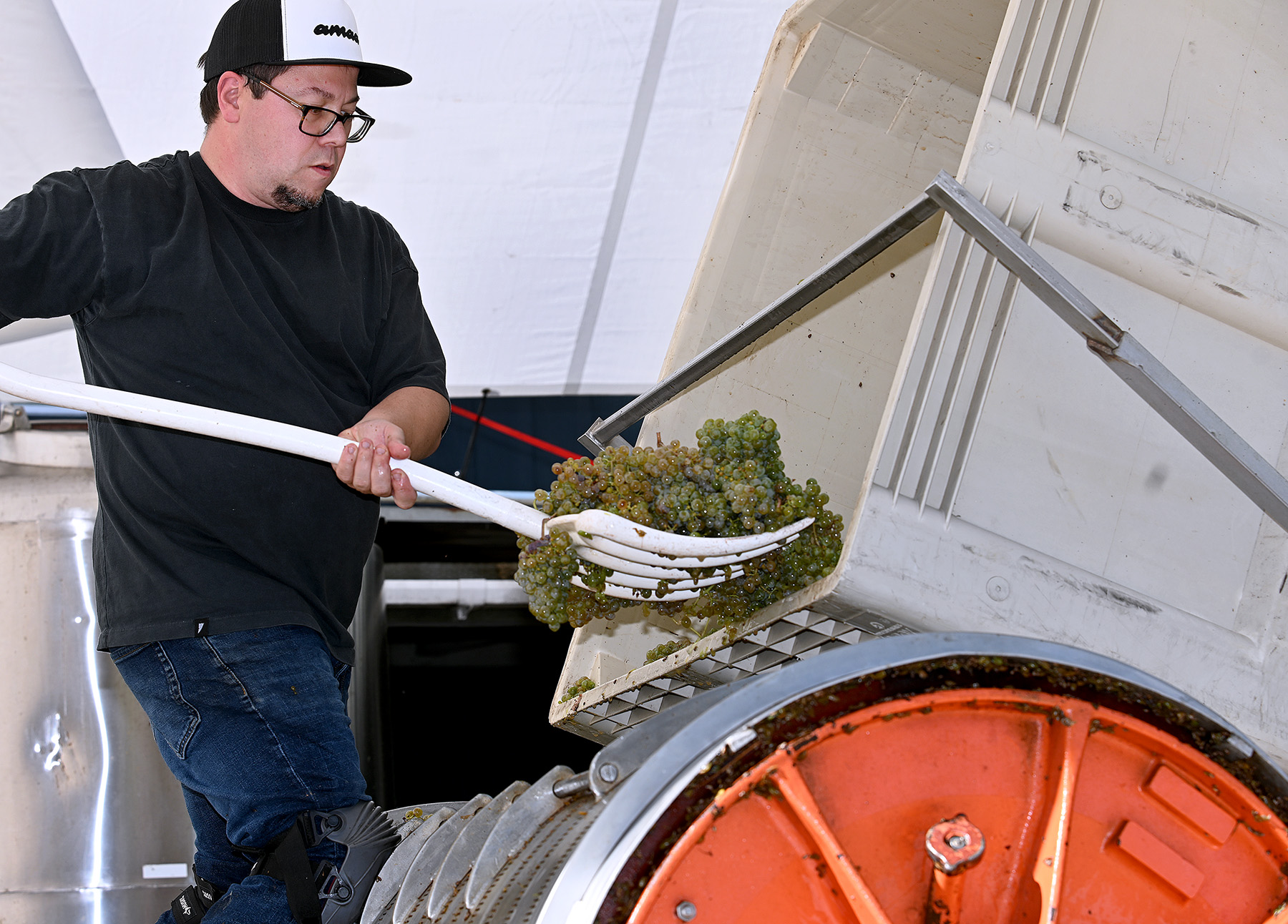
By Nicole Montesano
Smoke Signals staff writer
Grand Ronde Tribal member David Harrelson has branched off in a new direction this year, following his passion for history and his interest in food to a side business in winemaking.
Harrelson didn’t start out with an interest in wine; it grew slowly over several years. There was a college professor’s stories about his son’s new vineyard, a neighbor’s request for help with the harvest and a trip to the Caucasus Mountains, located at the border of Europe and Asia.
When he and his family moved to Dundee, Harrelson said, he wasn’t particularly interested in wine, much less in wine-making. But as “the heart of Oregon wine country,” Dundee is a town that takes wine seriously.
“It’s kind of everywhere,” he said. “I met neighbors and my neighbors worked in the wine industry. We moved to Dundee in 2013 and I knew little or nothing about wine, moving into town, but slowly and surely it increased …. your friend’s like, ‘Hey, I need help on the sorting line.’ I found myself working aspects of harvest or picking grapes or doing this, just being neighborly.”
Then there was the historic aspect of this most ancient beverage.
“In 2019, I went to the Republic of Georgia, sort of along my pursuit of loving food and realizing that they had a whole food culture there that I didn’t know anything about and so I got really interested to learn more,” Harrelson said. “And so that was part one of one of my pull toward that place. Part two was that I asked the question where the oldest signs of winemaking are in the world, and that’s the Caucasus Mountains.”
People there still routinely make their own wine at home in traditional clay vessels. Rather than the familiar white or red wine of Western culture, Harrelson said, Georgians make amber wine.
“You take white grapes and let them sit on the skins, like you do with red wine,” he said. “It pulls the color out and makes this beautiful golden-hued wine.”
Harrelson said he was hooked.
“I wanted to find a way for me to make amber wine in clay vessels,” he said.
And he knew where to find the vessels, thanks to that college professor’s stories about his son’s venture into growing grapes.
“There’s one manufacturer of clay vessels in the United States,” Harrelson said. “Otherwise, you have to buy them from Italy or Portugal. And the one manufacturer of those is a man named Andrew Beckham, who as chance would have it, is the son of Stephen Dow Beckham, the historian who’s worked with our Tribe for over 50 years and was my college advisor. And Andrew and I, about 10 years ago, started to become friends through being introduced through his dad. And Andrew (is) one of a handful of people who sort of made awareness of wine a little bit more familiar to me and then encouraged me in different ways and so that relationship was very helpful.”
In 2020, Harrelson tried his own hand at making wine in the traditional Georgian manner, using clay pots.
“I made wine in my garage as a hobby winemaker, from 2020 through the 2023 harvest,” he said. “I had my first commercial production started in the 2024 vintage. And I released those 24 wines in February of 2026. … It’s going well enough that I’m going to keep making it.”
Harrelson makes several types of wine; amber, red, white, a sparkling white and a non-alcoholic wine.
“I have six current offerings, six different bottlings and this January I’ll be bottling another four wines,” he said. “One is a repeat but a different vintage of Coyote’s eyes. The others will all be unique wines.”
He’s not giving up his day job, he said, as he still enjoys working as the Tribe’s Cultural Resources Department manager. But he also enjoys spending some of his free time in a very different venue, where the work is hands-on.
“It’s a creative outlet for me,” he said.
Cultural relevance is quietly threaded throughout Harrelson’s endeavor. amaa Wine is named for the Kalapuya word for home.
“I named it that because to me, the best type of wine that I enjoyed was in Georgia, where wine was approachable, it was a part of everyday living and it was in the home,” Harrelson said. “Everyone there made wine in their garage. Everyone had home wine and I was like, ‘Oh, I want to live in place like that, where wine is approachable and it’s accessible and it’s to be enjoyed.’”
He has named one of his wines, Wine Alley, in a nod to a road on the reservation where Tribal winemakers plied their skills throughout Prohibition. Another is named Coyote’s Eyes, not for the rich golden color, but for the flavor.
“When I first tasted the wine that I made, it tasted really strongly of rose and immediately what came to my mind was the Chinuk Wawa word for rose hips, which is t’alapas siyaxus,” he said. “And t’alapas siyaxus means Coyote’s Eyes. It’s because in the ikanum, or the creation stories, Coyote loses his eyes, and then he reaches out and he grabs rose hips and puts rose hips in his eyes. And so, it’s like this cultural frame of reference for me. … it has this, like, layered understanding, and that’s a really important thing for me in building a brand and sharing it, is that I want it to reflect place. I want it to reflect me and my culture but I’m not trying to do that loudly. It needs to be able to stand alone by itself. It’s a great value-added, but it’s not the story in and of itself.”
Harrelson acknowledged that many people want to know how his endeavor fits in with the troubling issue of high alcoholism rates among Indigenous people.
“They’re like ‘Well, how does this work, David?’ and part of it for me is this isn’t new,” he said. “Tribal people have continued to make wine. I have family members who have throughout their life and continue to be really active in AA. I was brought up around that, I had my own, like, check-in, with my family. It was one of the commitments and processes about my own consumption of alcohol, when I became a young person.”
But as he grew up, Harrelson said, “I was exposed to the possibility of having an actual healthy relationship with alcohol. I do think that’s possible. I don’t think that’s possible for everyone. It is one of the influences for me of why I make a non-alcoholic wine, is because I love the community part of what wine offers, in convening and gathering, but I also don’t want people to feel excluded.”
Alcohol abuse can mask deeper issues, he said.
“In a lot of instances, alcohol and the abuse of alcohol is about people self-medicating, and it’s oftentimes the symptom of the other things that are going on,” he said. “It can become the scapegoat or the target, but one thing that I’ve seen throughout my life, in people that I’m very close with who went through programs, is that even when they get rid of the alcohol, they still have the ‘ism’ and they have to work on the ‘ism.’ And so I would say that my hope is that we can create and we can model healthy relationships with alcohol, that there’s a possibility of that existing, with the full understanding that it’s not one that exists for everyone and that we need to support our community members in the ways that are meaningful to them.”